I would like to know the difference between dBo and dBe in relation to dBm. Does fiber optics have a specific matching impedance like the 50 ohm reference? Is this just a convention or is there an equation that specifies dBo for optics and photons to a dBe for RF or electrical parameters. These are all power related where the equivalent will be a watt or J*s answer.
Asked
Active
Viewed 3,254 times

3 Answers
2
dBo = The optical Loss in dB,
dBe = The electrical loss in dB,
This is most notably used in RF over Fiber applications.
1 dBo of Optical loss = 2 dBe of RF Loss, this is due to the fact that the converted RF power is related to the square of the optical power. Of course this is on the reception side. Transmission is an inherently low efficiency process so the inverse mapping should not be applied.
They are not directly related to dBm as they are loss factors and are applied equally to all power measures. In other words they are not referenced to anything but are scaling factors.

placeholder
- 30,170
- 10
- 63
- 110
1
The distinction between dBo and dBe comes up when measuring the frequency response of an optical receiver. For example,
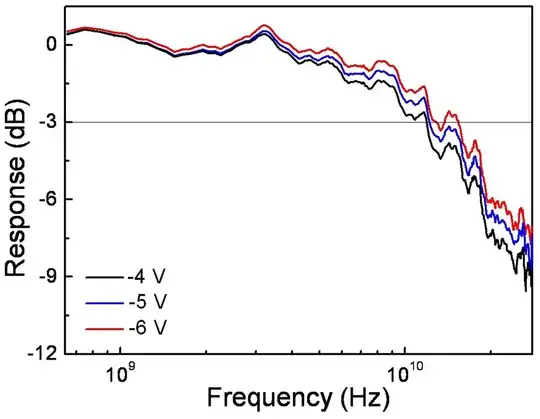
Since this graph doesn't specify dBe or dBo we don't know if they've plotted
- The apparent change in optical signal amplitude (dBo)
or
- The electrical response of the receiver (dBe)
in either case, assuming the optical input modulation amplitude is kept constant as frequency is increased.
The response in dBe can typically be obtained from the response in dBo by simply multiplying by two, because optical receivers are typically square-law devices (they output a current proportional to the input power).
Some receiver manufacturers might prefer to specify the response in dBo because it allows them to quote a higher -3 dB bandwidth.

The Photon
- 129,671
- 3
- 164
- 309
0
Where dBm is a measurement of power level relative to a single milliwatt, dBo is a measurement of amplitude comparative to a variable distance, and dBe is to be used in reference to a true electrical circuit's absolute power.
In legacy audio equipment, the impedence was measured to a 600 ohm standard. In radio, a 50 ohm standard. In a fiberoptic network, though, the impedence is not measured to an impedence standard, as the measurements are against photonic wave-particles in an enclosed environment, and not subject to traditional environmental effects.

James Brewer
- 101
- 3
-
The power of a signal in an optical fiber is not related to any 50 ohm standard. Since we practically never measure any field variables (voltage, electrical field) and we just measure optical power directly in watts, there's no need to consider the impedance of the fiber. We can simply measure power ratios as power ratios. – The Photon Sep 12 '14 at 23:35
-
That makes a lot of sense, actually, since in an optical fiber transmission we're dealing with photonic wave-particles instead of electrical current. Removing that portion of my answer, so as not to confuse readers. – James Brewer Sep 12 '14 at 23:41