The following circuit modulates the SIG wave with a 1kHz CLK signal and produces the OUT resulting wave.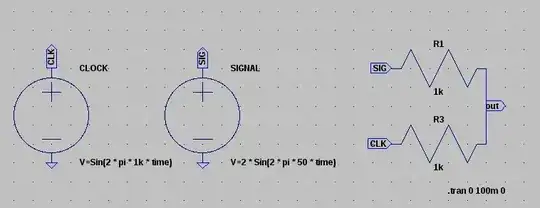
I have read that the superimposed wave has an amplitude of the sum of the original waves. If two waves are ASIN(wt) and BSIN(wt) then the superimposed wave has an amplitude of A+B.
What I don't understand is why the OUT wave has less amplitude than then the SIG wave, when the SIG and the CLK are in phases!
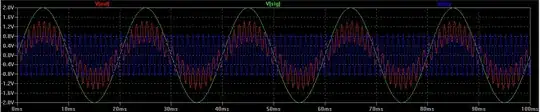
If we zoom in we can see some detail:
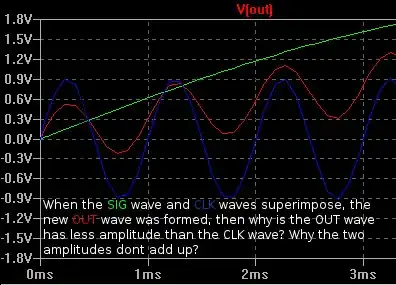
The amplitude of SIG wave is = 2V The amplitude of CLK wave is = 1V
How to calculate the amplitude of the OUT wave?


