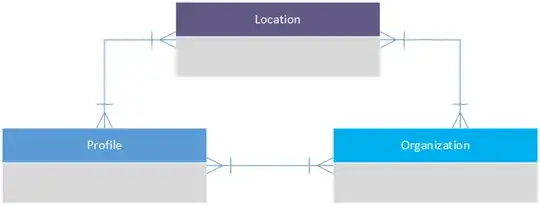
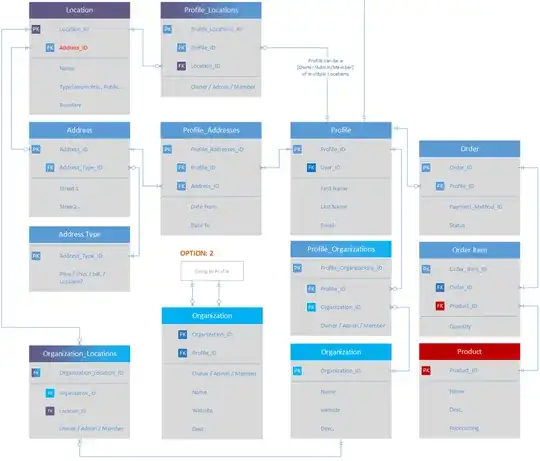
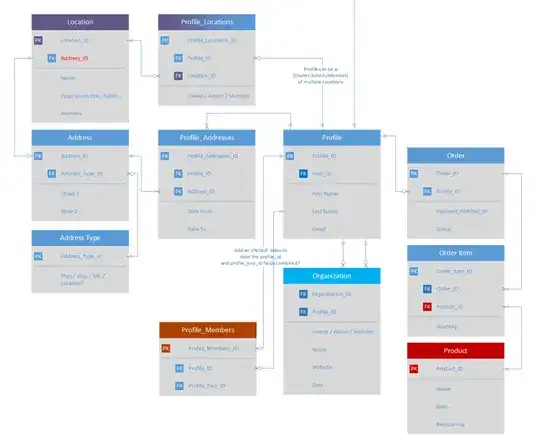
It is great that you are taking the time to understand, classify and model the data you are dealing with since, from my personal experiencie, all this makes the whole development process easier and very flexible for future changes. And I am quite sure that you are also aware of this already.
Preliminary data model and assumed business rules
I defined a list of business rules that I have assumed after reading your question and examining closely your diagrams, in order to describe my understanging of your specifications. After defining such list, I derived an IDEF1X[1] data model that I decided to upload as a .PDF document in an external platform (Dropbox), since due to its format this data model does not fit well in an embedded image. These two instruments are going to be useful as references for some important points that I enumerate below in the section entitled Aspects to resolve in order to keep moving forward.
First, here is the…
Since it is only that, preliminary, consider it as an means helping us to acomplish the desired final data model.
Assumed business rules
Said preliminary data model was derived from a collection of business rules (inferred from your question) that I will enumerate as follows:
Organizations and profiles
Note that Profile is currently understood as a synonym for Person.
- An
Organization is a friend of one-to-many Profiles.
- An
Organization is a friend of one-to-many Organizations.
- An
Organization is a member of one-to-many Organizations.
- A
Profile is a member of one-to-manyOrganizations.
- A
Profile is a friend of one-to-many Profiles.
- A
Profile is a member of one-to-many Profiles.
Locations and addresses
An Organization owns one-to-many Locations.
A Location is classified by one-to-many LocationTypes (only one at a given point in time).
A Location may have one-to-many Addresses (one Physical, one for Shipping, one for Billing, or one that serves all said purposes, or one that combines two purposes and another that serves only one of them).
An Address may be kept by one-to-many Profiles or, put another way, a Profile keeps one-to-many Addresses.
A specific Address may be used by one-to-many Profiles (serving as Physical for one Profile, being used for Billing by a different one, etc.). So, an Address works in a similar way for Locations and Profiles.
- Thus, an individual
Address may be, at the same time, of type Physical, Shipping and Billing.
Locations and roles
- A
Location opens one-to-many Roles.
- A
Role may be carried out in one-to-many Locations.
- A
Profile (once it has been set as Member of an Organization) may carry out one-to-many Roles, in one-to-many Locations (but only one specific Role in each Location at a particular point in time, i.e., never two or more Roles at the same time).
Aspects to resolve in order to keep moving forward
In order to keep advancing in the resolution of your data model, here is a list of relevant points that, once we work them out, are going to help us to reach this goal:
I have assumed that the term Profile in your context has a similar (or the same) meaning as that of Person, but it could be a bit different. In this way, would you say that, in your scenario, the entities Organization and Person are subtypes of Profile?
Can a Profile (or Person) own one-to-many EmailAddresses, or is a Profile (or Person) fixed to exactly one EmailAddress?
Would you like to provide the possibility for an Organization to be contacted via Telephone and Email, or you want to restrict that to be possible only for a Profile (or Person)?
I assume that a Location is fixed to exactly one Address of the type Physical, is this correct?
Is it possible for a Location to be shared by one-to-many different Organizations or, otherwise, a Location can be owned by only one Organization?
You have stated via comments that the fact of being a Member and a Friend is the same. As you can see in my proposed preliminary data model, I followed you original specifications and depicted all the possible combinations of membership and friendship between Organization and Profile (or Person) in different entities since I think that it can be helpful in the effort of defining the best possible structure for that part of your scenario. In this sense:
- I assume that the the statement
an Organization is a Member of another Organization has different effects than the statement a Profile (or Person) is a Member of an Organization regards the entity called Location.
- As you can see in the data model, I think that the
Role of Owner is only valid for an Organization and, to me, the valid Roles for a Profile (or Person), inside a Location are Admin and Member. What do you think about all this? Since you are in direct contact with the business rules that apply to your situation, you need to tell me if my assumptions are correct.
Can a Profile (or Person) play different Roles inside the same Location? i.e., can a Person be, at the same time, the Admin and also a Member of the same Location? What are the rules in this regard?
I think that the same Profile (or Person) can play different Roles in different Locations. For instance: A specific Profile (or Person) is the “Admin” in Location “1”, and this same Profile (or Person) is a “Member” in Location “2”, at the same time. Am I right?
Is it possible for a particular Location to have different LocationTypes at the same time, or is an individual Location fixed to hold exactly one LocationType?
Does the attribute Organization.Website represent the website address of a particular organization, such as “dba.stackexchange.com”?
If Profile “1” (understood as Person) is a Member (or Friend) of Profile “2”, is it possible for Profile “1” to carry out a Role in a Location owned by Profile “2”? I consider that such scenarios are only valid for the relationships between an Organization and a Member Person so, what do you think?
In a similar way, if Organization “1” is a Member (or Friend) of Organization “2”, is it possible for Organization “1” to carry out a Role in a Location owned by Organization “2”? Again, I think that this kind of scenarios are only valid for the relationships between an Organization and a Member Person, is this correct?
In this regard —while I am writing this questions— I think that it would be reasonable to say that there are only three different kinds relationships involving Organizations and Persons, and we can define:
- (a) The relationship between an
Organization and a Person as “Membership”.
- (b) The relationship between a
Person and another different Person as “Friendhip”.
- (c) We have yet to find a meaningful name in order to describe the relationship between an individual
Organization and another different Organization.
- So, let me know what you think about (a), (b) and (c).
Is it possible for an Organization to be a Friend (or a Member) of one-to-many different Organizations at the same time? Or it is only possible for an Organization to have only a relationship with exclusively one different Organization?
Successive data model depicting the first advance
In attention to your responses and resolutions to the pending aspects that I have listed above, I have created the following…
Although I do not feel quite comfortable with it yet, this new data model expresses the following business rules:
- A
Profile is either an Organization or a Person.[2]
- A
Profile may be the offering friend of one-to-many FriendProfiles, and a Profile may be the accepting friend of one-to-many FriendProfiles.[3]
- A
Location may consist of one-to-many Locations.[4]
Answers to your subsequent specific comments
It's really interesting for me to note/compound the separation of concerns [e.g. LocationAddress and ProfileAddress] - for I obviously wanted to rush in and hold them all without the correct relations [funnily, It didn't feel right with my original ERD].
Yes, that is a good comparison, although I would not call it separation of concerns (which is, certainly, a fundamental principle in application programming and design), since this term commonly pertains to the application development stage and we currently find ourselves in the stage of understanding the data and designing its logical structure.
From my personal experience, I consider that this phase has to do with putting the significant things into their whole context, it has to do with seeing the associations that exist between the different entities that are of relevance in the particular scenario of interest, and then depicting these things in a data model. In the specific case on which you are commenting about, the Address entity may have different kinds of connections with other entities, one with Profile and a different one with Location.
And, yes, when something does not feel right or natural, it may well be a sign that one needs to put more effort in order to understand the pertinent data. In this manner, the Address entity is one of the things that I consider that needs more attention, since I think that the relationship between a Profile and an Address could be handled by means of the Location entity (due to the fact that every Location must have at least one physical Address), therefore we could dismiss the ProfileAddress associative entity depicted in the latest model, but you should continue analizing these points and let me know your ideas.
Also, is it common practice in IDEF1X to change PK/FK denotions in entities for better readability [e.g ProfileId - LocationOwnerProfileId]?
Yes, that is a very clever remark from you, since IDEF1X recommends the use of role names for denominating FOREIGN KEYS, in order to capture the meaning of such attributes in accordance to the entity in which it is being used. It is also worth noting that this is also strongly related to the concept of primary keys migration. As a matter of fact, the use of role names precedes IDEF1X, since it was originally presented by Dr. E. F. Codd in his 1970 seminal text. In this manner, one can clearly see the fidelity that the IDEF1X standard keeps towards the relational model.
I'd be intrigued to learn what you don't particularly like/feel it doesn't model, with/in the solution?
Besides the details already described above about the Address entity, I am not sure if the Roles carried out by a given Profile in a particular Location are equivalent for an Organization or an Person. From my perspective, a Person first needs to be associated with an Organization, and then this Organization would appoint said Person to perform a Role in a particular Location, but you know the scenario better, so this rules may be needless. In this regard, I am going to insist about the fact that it would be very helpful for me to know the contextual description or meaning that the future users of this data structure give to Organization, Profile, and Location, but I understand that this may be considered confidential information, so this would be a limitation.
With the current structure, it seems like everyone (Organization or Person) can be related to anyone (again, Organization or Person) and can be/do anything (Role) anywhere (Location) but, perharps, this is preciselly what you and the users are expecting from this database, for which you will provide well defined constraints, of course. If this is the case, then we are almost providing a final solution. Since, naturally, your opinion is decisive in this situation, you should also analize this ideas and then let me know your conclusions so that we can take the final steps.
Feasible second advance
Unfortunately, the comunication stopped a few weeks ago, I guess because of work commitments that you must meet, which is completely reasonable. I would have been much more content if we had developed a more stable and robust model but, due to our previous interactions, I can assume that I have been able to point you in the right direction.
In addition to what has already been presented in this question and answer process, I consider that providing a new progression from the previous data models may be helpful for other seekers with a similar problem. So, I have created the…
Organizations and Profiles Preliminary Data Model — Second Advance
As can be seen in such data model, I have removed the many-to-many relationship that I have depicted in the preceding models between Profile and Address, since a given Profile is already related to one-to-many Addresses via its owned Locations.
Another change that is illustrated in this new advance is the fact that it now includes the possibility that a given Location can be owned by one-to-many Profiles. Consequently, I have changed the Location PRIMARY KEY (by dismissing the LocationOwnerProfileId attribute) and then added an associative entity (many-to-many) that relates Profile with Location.
Notes
1. IDEF1X is a highly recommendable data modeling technique that was defined as a standard in december 1993 by the U.S. National Institute of Standards and Technology (NIST).
2. This is an ocurrence of a (super)type-subtype cluster. In case you are interested, here is an answer in which I deal in a more detailed manner with this kind of relationships.
3. An example of a many-to-many hierarchical relationship, and is very simliar to the structure that gave definitive solution to the “Parts Explotion Problem”. Such solution was, of course, introduced by Dr. Edgar Frank Codd in his 1970 enormously influential paper “A Relational Model of Data for Large Shared Data Banks”.
4. As such, this is an instance of a one-to-many (or many-to-one) hierarchical relationship.