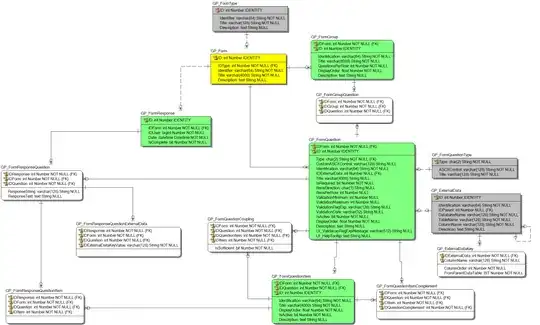
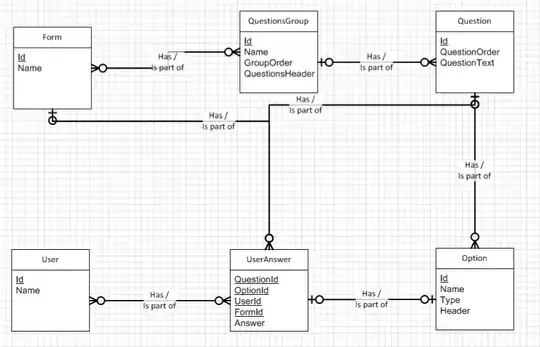
I offer a more complete model, from an actual solution.
The 'type' is associated to the question per-se (not to its items, as stated at the fourth item from the question).
A question may be of single-line or multiple-line textual box or composed by several items. For each item may be assigned a complementary question (eg. 'Country?' - 'Other' - 'Which: ___').
HOW the question and its items will be presented to the user depends on their type.
The model has been made flexible enough to represent several structures of questions.
The 'FormQuestionType' entity has an attribute to identify the ASCX (ASP.net component) responsible of rendering questions of this type.
It's possible to make a question dependent of one or more of the previous ones (eg. 'How many children?' may be made dependent of 'Do you have any children?').
There's prevision for data validation, from 'required' constraint to regular expressions.
For every major entity has been defined the mandatory and unique attribute named 'identification', allowing queries based upon textual codes instead of numerical ids (eg. 'How many children?' question, of id '351', is also identified by 'HOW_MANY_CHILDREN').
And, for the items of a given questions, there may be defined an external source of data (eg. 'city' question has its options retrieved live from corporate 'city' table).
The actual model provide versioning, but, for clarity's sake, I present a stripped down version of it.