I have a table set up like this:
The DB has 10B rows.
CREATE TABLE [Tick].[X_H](
       [utcDT] [datetime2](7) NOT NULL,
       [Symbol] [nvarchar](50) NOT NULL,
       [Bid] [float] NULL,
       [Ask] [float] NULL,
       [BidSize] [float] NULL,
       [AskSize] [float] NULL
) ON [PRIMARY]
ALTER TABLE [Tick].[X_H] ADD  CONSTRAINT [PK_Master] PRIMARY KEY CLUSTERED
(
       [utcDT] ASC,
       [Symbol] ASC
)WITH (PAD_INDEX = OFF, STATISTICS_NORECOMPUTE = OFF, SORT_IN_TEMPDB = OFF, IGNORE_DUP_KEY = ON, ONLINE = OFF, ALLOW_ROW_LOCKS = ON, ALLOW_PAGE_LOCKS = ON)
I want to select a single day's worth of data for a particular Symbol. I am using:
SELECT *
FROM [Tick].[X_H]
WHERE [Symbol] = 'DONKEY'
AND CONVERT(Date, [utcDT]) = CONVERT(Date,'2011-01-02');
This takes 3 times longer than reading the same data from a binary file and deserialising it. Binary read is 42ms and SQL read is 115ms.
What might I try to speed it up?
The suggestion was made to create a separate [Date] column, which I have and I added 2 indexes.
ALTER TABLE [Tick].[FX_HS] ADD [Date] DATE NULL;
UPDATE [Tick].[X_H] SET [Date] = CONVERT(Date,[utcDT])
CREATE INDEX I_Date ON [Tick].[X_H] ([Date]);
CREATE INDEX I_SymbolDate ON [Tick].[X_H] ([Symbol],[Date]);
And I am using query:
SELECT * FROM [Tick].[X_H] WHERE [Symbol] = 'DONKEY' AND [Date] = '2011-01-02';
But it takes approximately the same amount of time!
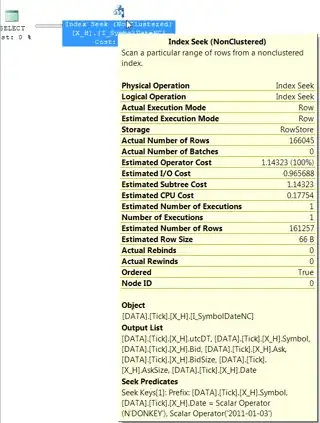
Execution plan
Query 1: Query cost(relative to batch): 100%
SELECT * FROM [Tick][X_H] WHERE [Symbol]=@1 AND [Date]=@2
As Martin Smith suggested:
SET STATISTICS TIME ON
DECLARE @utcDT DATETIME2(7)
DECLARE @Symbol NVARCHAR(50)
DECLARE @Bid FLOAT
DECLARE @Ask FLOAT
DECLARE @BidSize FLOAT
DECLARE @AskSize FLOAT
DECLARE @Date DATE
SELECT @utcDT = utcDT,
       @Symbol = Symbol,
       @Bid = Bid,
       @Ask = Ask,
       @BidSize = BidSize,
       @AskSize = AskSize,
       @Date = Date
FROM   Tick.X_H
WHERE  ( Symbol = 'DONKEY' )
       AND ( Date = '2011-01-02' )
This takes:
SQL Server parse and compile time: CPU time = 0 ms, elapsed time = 0 ms.SQL Server Execution Times: CPU time = 47 ms, elapsed time = 43 ms.


