I didn't see official documentation answering your questions, but some of these things you can yourself (on a testing/dev server first!). Here's what I found:
Unless you are hoping to use a very large number of concurrent locks, you likely will not have any problems. On SQL Server 2017 CTP2.1, I was able to acquire 1MM concurrent locks in about 26 seconds. There were no collisions, and this appeared to use ~286MB of memory.
The SQL Server documentation specifies a maximum of 2,147,483,647 locks for 32 bit and "Limited only by memory" for 64 bit (which I assume you're using).
Test script
Below is a script that acquires 1MM locks and does basic monitoring of the elapsed time, memory consumed, collisions encountered.
BEGIN TRAN;

DECLARE @result INT,
    @i INT = 1,
    @locks_attempted INT = 1000000,
    @locks_acquired INT,
    @ts DATETIME2 = SYSDATETIME();

WHILE (@i <= @locks_attempted)
BEGIN
    DECLARE @Resource NVARCHAR(255) =
        'LongStringSoThatTheFirst32CharactersAreIdentical_' + CAST(@i AS VARCHAR)
    EXEC @result = sp_getapplock @Resource = @Resource, @LockMode = 'Exclusive';
    IF (@result <> 0) THROW 50000, 'Failed to acquire lock', 0
    SET @i = @i + 1;
END

DECLARE @elapsed_ms INT = DATEDIFF(MILLISECOND, @ts, SYSDATETIME());

SELECT @locks_acquired = COUNT(*)
FROM sys.dm_tran_locks
WHERE request_session_id = @@SPID
    AND resource_type = 'APPLICATION';

-- Acquired 1000000 of 1000000 locks in 26351 milliseconds
RAISERROR('Acquired %i of %i locks in %i milliseconds', 0, 1,
    @locks_acquired, @locks_attempted, @elapsed_ms);

-- ~286MB of memory for OBJECTSTORE_LOCK_MANAGER
SELECT *
FROM sys.dm_os_memory_clerks
WHERE type = 'OBJECTSTORE_LOCK_MANAGER';

ROLLBACK;
What about collisions?
I didn't observe collisions in any of my trials, but based on the documentation for sys.dm_tran_locks, it does appear that a 32 bit hash is used. With such a short hash, the odds of a collision should be fairly high (see chart below). However, even with 10MM concurrent locks, I did not achieve a collision. This might indicate that the hash is more complex under the hood, and that the resource_description column of sys.dm_tran_locks simply shows the first 32 bits of the hash (similar to the way it shows only the first 32 characters of the @Resource parameter). Or it might indicate that I was lucky.
If you are going to use this strategy, you should check to see if you get any collisions on your actual data. If you do, you could try to put unique elements (e.g., the schema_id, object_id, and your rowid) at the beginning of the @Resource. (It's not fully clear, but the documentation suggests that the first 32 characters of @Resource might be combined with the hash in order to uniquely identify the lock.)
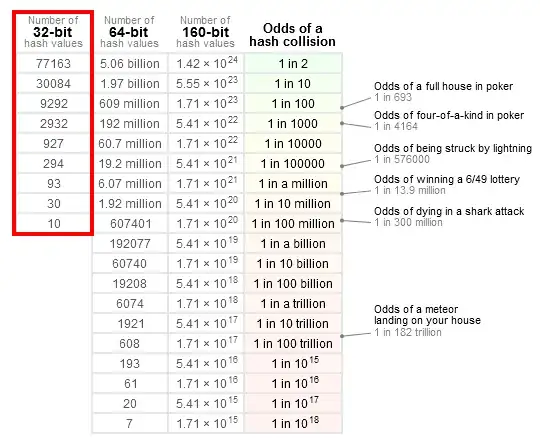
(Image from Preshing on Programming)
Why do you want to do this?
It seems unusual to use sp_getapplock so heavily for something that seems similar the type of row-level locking that SQL Server provides on its own. I'm assuming you've carefully considered other approaches, but if you haven't yet done so, you might want to think about other solutions that don't involve sp_getapplock.


