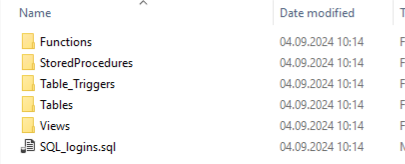
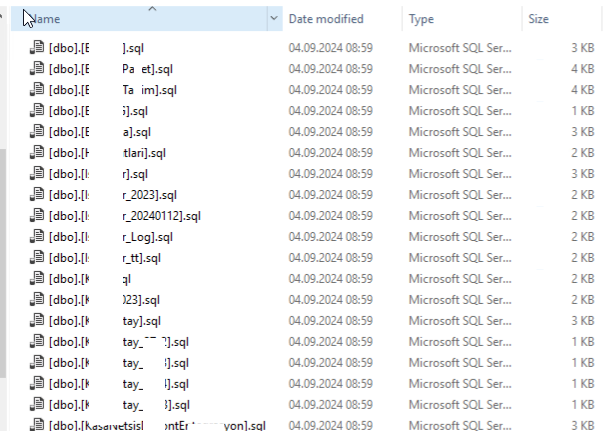
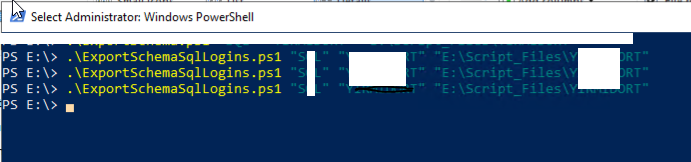
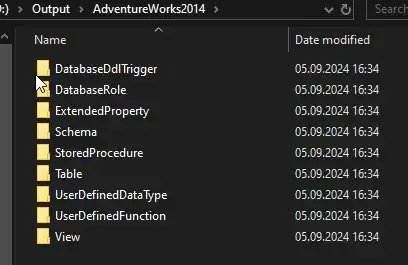
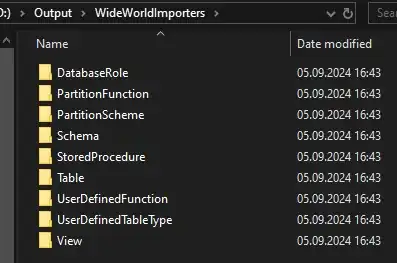
# Usage:  powershell .\ExportSchemaSqlLogins.ps1 "SERVERNAME" "DATABASE" "C:\YourOutputPath\DATABASE"
Start Script
Set-ExecutionPolicy RemoteSigned
Set-ExecutionPolicy -ExecutionPolicy:Unrestricted -Scope:LocalMachine
function ExportSchema([string]$serverName, [string]$dbname, [string]$scriptpath)
{
  [System.Reflection.Assembly]::LoadWithPartialName("Microsoft.SqlServer.SMO") | Out-Null
  [System.Reflection.Assembly]::LoadWithPartialName("System.Data") | Out-Null
1.0 Sql Server Connection Part
$srv = new-object "Microsoft.SqlServer.Management.SMO.Server" $serverName
$srv.SetDefaultInitFields([Microsoft.SqlServer.Management.SMO.View], "IsSystemObject")
1.1 Sql Server Database Connection Part
$db = New-Object "Microsoft.SqlServer.Management.SMO.Database"
  $db = $srv.Databases[$dbname]
$deptype = New-Object "Microsoft.SqlServer.Management.Smo.DependencyType"
1.3 SMO Scripter part | object
What specific part of SMO makes this task easy?
$scr = New-Object "Microsoft.SqlServer.Management.Smo.Scripter"
  $scr.Server = $srv
  $options = New-Object "Microsoft.SqlServer.Management.SMO.ScriptingOptions"
What specific part of SMO makes this task easy?
$options.AllowSystemObjects = $false
  $options.IncludeDatabaseContext = $true
  $options.IncludeIfNotExists = $false
  $options.ClusteredIndexes = $true
  $options.Default = $true
  $options.DriAll = $true
  $options.Indexes = $true
  $options.NonClusteredIndexes = $true
  $options.IncludeHeaders = $false
  $options.ToFileOnly = $true
  $options.AppendToFile = $true
  $options.ScriptDrops = $false
Set options for SMO.Scripter
$scr.Options = $options
#=============
Tables
#=============
Foreach ($tb in $db.Tables)
  {
  $options.FileName = $scriptpath + "\Tables$($tb).sql"
  New-Item $options.FileName -type file -force | Out-Null
If ($tb.IsSystemObject -eq $FALSE)
   {
    $smoObjects = New-Object Microsoft.SqlServer.Management.Smo.UrnCollection
    $smoObjects.Add($tb.Urn)
    $scr.Script($smoObjects)
   }
  }
#=============
Views
#=============
$views = $db.Views | where {$_.IsSystemObject -eq $false}
  Foreach ($view in $views)
  {
  $options.FileName = $scriptpath + "\Views$($view).sql"
  New-Item $options.FileName -type file -force | Out-Null
if ($views -ne $null)
{
 $scr.Script($view)

}
  }
#=============
StoredProcedures
#=============
  $StoredProcedures = $db.StoredProcedures | where {$_.IsSystemObject -eq $false}
Foreach ($StoredProcedure in $StoredProcedures)
  {
  $options.FileName = $scriptpath + "\StoredProcedures$($StoredProcedure).sql"
  New-Item $options.FileName -type file -force | Out-Null
    if ($StoredProcedures -ne $null)
    {

     $scr.Script($StoredProcedure)
   }
  }
#=============
Functions
#=============
  $UserDefinedFunctions = $db.UserDefinedFunctions | where {$_.IsSystemObject -eq $false}
Foreach ($function in $UserDefinedFunctions)
  {
  $options.FileName = $scriptpath + "\Functions$($function).sql"
  New-Item $options.FileName -type file -force | Out-Null
if ($UserDefinedFunctions -ne $null)
{
 $scr.Script($function)

}
  }
#=============
DBTriggers
#=============
  $DBTriggers = $db.Triggers
foreach ($trigger in $db.triggers)
  {
  $options.FileName = $scriptpath + "\Db_Triggers$($trigger).sql"
  New-Item $options.FileName -type file -force | Out-Null
    if ($DBTriggers -ne $null)
    {
      $scr.Script($DBTriggers)
    }
  }
#=============
Table Triggers
#=============
Foreach ($tb in $db.Tables)
  {

    if($tb.triggers -ne $null)
    {
      foreach ($trigger in $tb.triggers)
      {
      $options.FileName = $scriptpath + "\Table_Triggers$($tb)_$($trigger).sql"
      New-Item $options.FileName -type file -force | Out-Null
        $scr.Script($trigger)
      }
    }
  }
}
#$conn = New-Object Microsoft.SqlServer.Management.Common.ServerConnection
#$conn.ConnectionString = "Data Source=SERVERNAME;Initial Catalog=DATABASE;User ID=sqlusername;Password=sqluserpass;MultipleActiveResultSets=True;Application Name=Powershell"
#ExportSchema "SERVERNAME" "DATABASE" "E:\Script_Files\DATABASE"
function ExportSQLLogins{
    [cmdletbinding()]
    param([parameter(Mandatory=$true)][string] $source
            ,[string] $ApplyTo
            ,[string[]] $logins
            ,[string] $outputpath) #=([Environment]::GetFolderPath("MyDocuments"           ))
#Load assemblies
[System.Reflection.Assembly]::LoadWithPartialName('Microsoft.SqlServer.SMO') | out-null
#create initial SMO object
$smosource = new-object ('Microsoft.SqlServer.Management.Smo.Server') $source
#Make sure we script out the SID
$so = new-object microsoft.sqlserver.management.smo.scriptingoptions
$so.LoginSid = $true
#set output filename
#$filename = $source.Replace('/','') + '' + (Get-Date -Format 'yyyyMMddHHmm') + '_logins.sql'
$filename = $source + '_logins.sql'
$outfile = Join-Path -Path $outputpath -ChildPath $filename
#If no logins explicitly declared, assume all non-system logins
if(!($logins)){
    $logins = ($smosource.Logins | Where-Object {$_.IsSystemObject -eq $false}).Name.Trim()
}
foreach($loginname in $logins){
    #get login object
    $login = $smosource.Logins[$loginname]
#Script out the login, remove the "DISABLE" statement included by the .Script() method
$lscript = $login.Script($so) | Where {$_ -notlike 'ALTER LOGIN*DISABLE'}
$lscript = $lscript -join ' '

#If SQL Login, sort password, insert into script
if($login.LoginType -eq 'SqlLogin'){

  $sql = "SELECT convert(varbinary(256),password_hash) as hashedpass FROM sys.sql_logins where name='"+$loginname+"'"
  $hashedpass = ($smosource.databases['tempdb'].ExecuteWithResults($sql)).Tables.hashedpass
  $passtring = ConvertTo-SQLHashString $hashedpass
  $rndpw = $lscript.Substring($lscript.IndexOf('PASSWORD'),$lscript.IndexOf(', SID')-$lscript.IndexOf('PASSWORD'))

  $comment = $lscript.Substring($lscript.IndexOf('/*'),$lscript.IndexOf('*/')-$lscript.IndexOf('/*')+2)
  $lscript = $lscript.Replace($comment,'')
  $lscript = $lscript.Replace($rndpw,"PASSWORD = $passtring HASHED")
}

#script login to out file
$lscript | Out-File -Append -FilePath $outfile

#if ApplyTo is specified, execute the login creation on the ApplyTo instance
If($ApplyTo){
    $smotarget = new-object ('Microsoft.SqlServer.Management.Smo.Server') $ApplyTo

    if(!($smotarget.logins.name -contains $loginname)){
        $smotarget.Databases['tempdb'].ExecuteNonQuery($lscript)
        $outmsg='Login ' + $login.name + ' created.'
        }
    else{
        $outmsg='Login ' + $login.name + ' skipped, already exists on target.'
        }
    Write-Verbose $outmsg
    }
}

}
function ConvertTo-SQLHashString{
  param([parameter(Mandatory=$true)] $binhash)
$outstring = '0x'
  $binhash | ForEach-Object {$outstring += ('{0:X}' -f $_).PadLeft(2, '0')}
return $outstring
}
#Create a SQL Script in My Documents for all logins
#Export-SQLLogins -source 'SQL'
#=============
Execute
#=============
ExportSchema $args[0] $args[1] $args[2]
ExportSQLLogins -source $args[0] -outputpath $args[2]