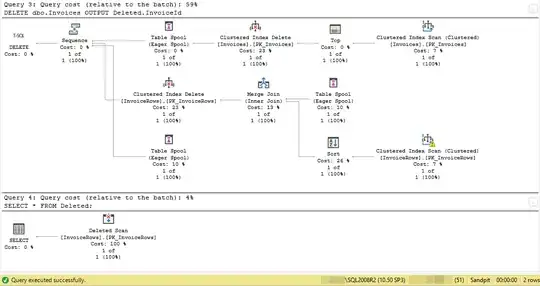
I have 2 tables with the cascade delete rule - [dbo].[Invoices] and [dbo].[InvoiceRows]:
CREATE TABLE [dbo].[Invoices]
(
    [InvoiceId] [int] IDENTITY(1,1) NOT NULL,
    --other columns
CONSTRAINT [PK_Invoices]
    PRIMARY KEY CLUSTERED ([InvoiceId] ASC)

)
GO
CREATE TABLE [dbo].[InvoiceRows]
(
    [InvoiceRowId] [int] IDENTITY(1,1) NOT NULL,
    [ProductId] [int] NOT NULL,
    [Price] [money] NOT NULL,
    [Quantity] [int] NOT NULL,
    [InvoiceId] [int] NOT NULL
    --other columns
CONSTRAINT [PK_InvoiceRows]
    PRIMARY KEY CLUSTERED ([InvoiceRowId] ASC)

)
ALTER TABLE [dbo].[InvoiceRows] WITH CHECK
    ADD CONSTRAINT [FK_InvoiceRows_Invoices]
        FOREIGN KEY([InvoiceId]) REFERENCES [dbo].[Invoices] ([InvoiceId])
             ON UPDATE CASCADE ON DELETE CASCADE
GO
ALTER TABLE [dbo].[InvoiceRows] CHECK CONSTRAINT [FK_InvoiceRows_Invoices]
GO

I want any change in the [dbo].[InvoiceRows] to cause a recalculation of some register.
For this I added a trigger:
CREATE TRIGGER [dbo].[TrInvoiceRows_Delete_UpdateProductRegister]
ON [dbo].[InvoiceRows]
AFTER DELETE
AS
BEGIN
    SET NOCOUNT ON;
PRINT 'TRIGGER Tr_InvoiceRows_Delete_UpdateProductRegister fired'

--trigger logic

END
All triggers fire correctly when I work directly with [dbo].[InvoiceRows]. The triggers work when I delete [dbo].[Invoices] using SSMS.
But recently I noticed that deleting [dbo].[Invoices] using Entity Framework generates the following code and the trigger IS NOT FIRED.
That is, there are no any errors; it just ignores the trigger.
EXEC sp_executesql
    N'
    SET IMPLICIT_TRANSACTIONS OFF;
    SET NOCOUNT ON;
    DELETE FROM [Invoices]
    OUTPUT 1
    WHERE [InvoiceId] = @p0; ',
    N'@p0 int',
    @p0=19936;
I noticed that the problem is OUTPUT 1 and compared the queries:

I realize that I have many options to fire a trigger on the application side (do not use EF or delete the cascade table rows first).
I want to know if it is possible to solve the problem on SQL Server ? That is, make the cascading table delete trigger always fire without any surprises.