I have some tables where I store data and depending on the type of person (worker / civil) that did a job I want to store it in an event table, now these guys rescue an animal (there is an animal table).
Finally, I want to have a table to store the event that a guy (worker / civil), saved an animal, but how should I add a foreign key or how to know the id value of the civil or worker that did the job?
Now, in this design I do not know how to relate which person did the job if, I would had only a kind of person (aka civil) I would only store the civil_id vale in a person column in this last table... but how to know if it was civil or worker, do I need other "intermediate" table?
How to reflect the design of the following diagram in MySQL?
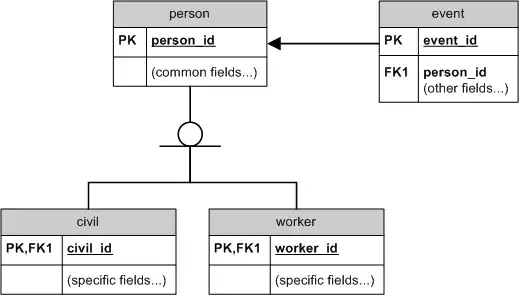
Additional details
I have modelled it the following way:
DROP    TABLE IF EXISTS `tbl_animal`;
CREATE TABLE `tbl_animal` (
    id_animal       INTEGER     NOT NULL PRIMARY KEY AUTO_INCREMENT,
    name            VARCHAR(25) NOT NULL DEFAULT "no name",
    specie          VARCHAR(10) NOT NULL DEFAULT "Other",
    sex             CHAR(1)     NOT NULL DEFAULT "M",
    size            VARCHAR(10) NOT NULL DEFAULT "Mini",
    edad            VARCHAR(10) NOT NULL DEFAULT "Lact",
    pelo            VARCHAR(5 ) NOT NULL DEFAULT "short",
    color           VARCHAR(25) NOT NULL DEFAULT "not defined",
    ra              VARCHAR(25) NOT NULL DEFAULT "not defined",
    CONSTRAINT `uc_Info_Animal` UNIQUE (`id_animal`)
) ENGINE=InnoDB  DEFAULT CHARSET=utf8;
INSERT INTO tbl_animal VALUES (1,'no name', 'dog', 'M','Mini','Lact','Long','black','Bobtail');
INSERT INTO tbl_animal VALUES (2,'peluchin', 'cat', 'M','Mini','Lact','Long','white','not defined');
INSERT INTO tbl_animal VALUES (3,'asechin', 'cat', 'M','Mini','Lact','Corto','orange','not defined');
DROP    TABLE IF EXISTS tbl_person;

CREATE TABLE tbl_person (
    type_person  VARCHAR(50) NOT NULL primary key

) ENGINE=InnoDB  DEFAULT CHARSET=utf8;
INSERT INTO tbl_person (type_person) VALUES ('Worker');
INSERT INTO tbl_person (type_person) VALUES ('Civil');
DROP    TABLE IF EXISTS tbl_worker;

CREATE TABLE tbl_worker(
    id_worker           INTEGER  NOT NULL PRIMARY KEY,
    type_person         VARCHAR(50) NOT NULL ,
    name_worker         VARCHAR(50) NOT NULL ,

    address_worker      VARCHAR(40) NOT NULL DEFAULT "not defined",

    delegation          VARCHAR(40) NOT NULL DEFAULT "not defined",
    FOREIGN KEY (type_person)               REFERENCES tbl_person (type_person),
    CONSTRAINT uc_Info_worker UNIQUE (id_worker)

) ENGINE=InnoDB  DEFAULT CHARSET=utf8;
INSERT INTO tbl_worker VALUES (1,'Worker','N_CEDENTE1', 'DIR Worker 1', 'DEL');
INSERT INTO tbl_worker VALUES (2,'Worker','N_worker1', 'DIR Worker 2', 'DEL');
INSERT INTO tbl_worker VALUES (3,'Worker','N_worker2', 'address worker','delegation worker');
DROP    TABLE IF EXISTS tbl_civil;
CREATE TABLE tbl_civil(
    id_civil                        INTEGER  NOT NULL PRIMARY KEY,
    type_person         VARCHAR(50) NOT NULL ,
    name_civil                      VARCHAR(50)  ,
    procedence_civil                VARCHAR(40)  NOT NULL DEFAULT "Socorrism",

  FOREIGN KEY (type_person)             REFERENCES tbl_person (type_person),
    CONSTRAINT uc_Info_civil UNIQUE (id_civil)

) ENGINE=InnoDB  DEFAULT CHARSET=utf8;
INSERT INTO tbl_civil  VALUES (1,'Civil','N_civil1' , 'Socorrism');
CREATE TABLE tbl_event (
    id_event     INTEGER NOT NULL,
    id_animal    INTEGER NOT NULL,
    type_person  VARCHAR(50) NOT NULL ,
    date_reception DATE DEFAULT '2000-01-01 01:01:01',
    FOREIGN KEY (id_animal)   REFERENCES tbl_animal    (id_animal),
    FOREIGN KEY (type_person )  REFERENCES tbl_person   (type_person ),
    CONSTRAINT uc_Info_ficha_primer_ingreso UNIQUE (id_animal,id_event)

)ENGINE=InnoDB  DEFAULT CHARSET=utf8;
INSERT INTO tbl_event VALUES (1,1, 'Worker','2013-01-01 01:01:01' );
INSERT INTO tbl_event VALUES (2,2, 'Civil','2013-01-01 01:01:01' );
However, is there a way to get rid of nulls?
The queries I have are:
SELECT  a.*,b.*,z.*
FROM    tbl_event a
        left JOIN tbl_worker b
            ON a.type_person = b.type_person
        left JOIN tbl_animal z
            ON   z.id_animal = a.id_animal ;
SELECT  a.,b.,z.*
FROM    tbl_event a
        left JOIN tbl_civil b
            ON a.type_person = b.type_person
        left JOIN tbl_animal z
            ON   z.id_animal = a.id_animal ;
Here is an updated sqlfiddle.


