5

I'm setting up a SQL Server 2012 lab on Windows 2008 R2 which has 5 SQL Servers. I registered SQL1 as my central management server and created a group under this server that includes all the servers and the CMS itself. I'm a bit confused since the documentation says the CMS cannot be a member of a group it maintains. However, I'm able to include it in the group, run multiple queries and evaluate policies successfully.

Reference: http://msdn.microsoft.com/en-us/library/bb895144.aspx see under "Related tasks"

I've seen other forum posts where users have issues registering the CMS itself but I don't have this problem at all. Has something changed?

I'm running SQL Server 2012 Enterprise SP1 and SSMS 2012.

Microsoft SQL Server 2012 (SP1) - 11.0.3128.0 (X64) Dec 28 2012 20:23:12 Copyright (c) Microsoft Corporation Enterprise Edition (64-bit) on Windows NT 6.1 (Build 7601: Service Pack 1) (Hypervisor)

Here's the CMS returning queries for the whole group.
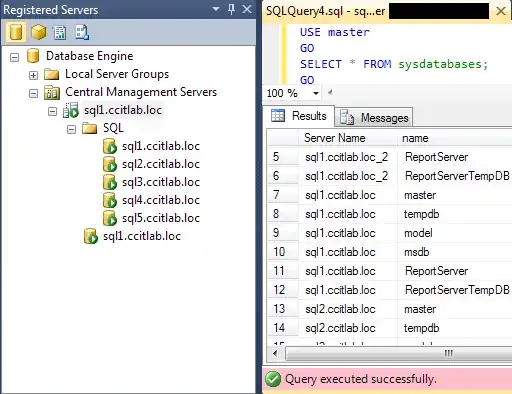
enter image description here

Paweł Czopowik
  • 203
  • 3
  • 8

2 Answers2

3

I had also previously assumed that this wasn't possible at all, until I started playing around with it.

From what I can tell, the matching is only done by the server network name that's entered.

If you attempt to add a server to the tree with the same network name, it won't allow it; however, if you use a different network name, even though it may point to the same instance, it does work.

For example, I successfully registered my local instance .\SQL2008R2DEV as a CMS, and then successfully registered (local)\SQL2008R2DEV in the tree. (Tested in 2012 Management Studio.)

From a management perspective, this may or may not be a good idea. Furthermore, if Microsoft decides to tighten down the policy, any reliance on this ability will force you to change your process.

Certainly if SQL1 would be a production instance in your case, this is a bad idea because you want to separate management duties from serving user data duties. I strongly recommend using a separate instance of SQL Server just for CMS purposes, particularly in a production environment.

Jon Seigel
  • 16,922
  • 6
  • 45
  • 85
1

Technically you can specify the central management server as the one under the managed groups. However, once the needed policies are tested (whatever their source is), the policies can be imported to the central management server which will perform the policies import to appropriate servers, including itself. This recursion should be tested as it may produce serious side effects. This is just a notification of the potential issue - I had no opportunity to test it

Ivan Stankovic
  • 637
  • 6
  • 6