Yes, SQL Server can, under some circumstances read one column's value from the "old" version of the row, and another column's value from the "new" version of the row.
Setup:
CREATE TABLE Person
  (
     Id      INT PRIMARY KEY,
     Name    VARCHAR(100),
     Surname VARCHAR(100)
  );

CREATE INDEX ix_Name
  ON Person(Name);

CREATE INDEX ix_Surname
  ON Person(Surname);

INSERT INTO Person
SELECT TOP 1000000 ROW_NUMBER() OVER (ORDER BY @@SPID),
                   'Jonny1',
                   'Jonny1'
FROM   master..spt_values v1,
       master..spt_values v2
In the first connection, run this:
WHILE ( 1 = 1 )
  BEGIN
      UPDATE Person
      SET    Name = 'Jonny2',
             Surname = 'Jonny2'

      UPDATE Person
      SET    Name = 'Jonny1',
             Surname = 'Jonny1'
  END
In the second connection, run this:
DECLARE @Person TABLE (
  Id      INT PRIMARY KEY,
  Name    VARCHAR(100),
  Surname VARCHAR(100));

SELECT 'Setting intial Rowcount'
WHERE  1 = 0

WHILE @@ROWCOUNT = 0
  INSERT INTO @Person
  SELECT Id,
         Name,
         Surname
  FROM   Person WITH(NOLOCK, INDEX = ix_Name, INDEX = ix_Surname)
  WHERE  Id > 30
         AND Name <> Surname

SELECT *
FROM   @Person
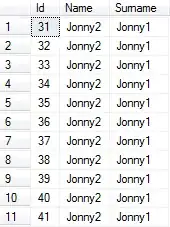
After running for about 30 seconds I get :
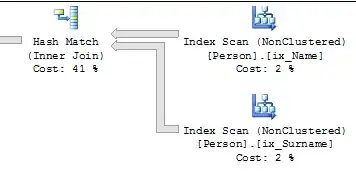
The SELECT query is retrieving the columns from the non clustered indexes rather than the clustered index (albeit due to the hints).
The update statement gets a wide update plan...
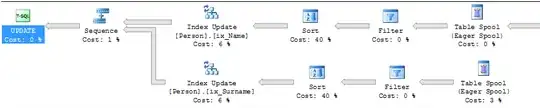
... and updates the indexes in sequence so it is possible to read "before" values from one index and "after" from the other.
It is also possible to retrieve two different versions of the same column value.
In the first connection, run this:
DECLARE @A VARCHAR(MAX) = 'A';
DECLARE @B VARCHAR(MAX) = 'B';

SELECT @A = REPLICATE(@A, 200000),
       @B = REPLICATE(@B, 200000);

CREATE TABLE T
  (
     V VARCHAR(MAX) NULL
  );

INSERT INTO T
VALUES     (@B);

WHILE 1 = 1
  BEGIN
      UPDATE T
      SET    V = @A;

      UPDATE T
      SET    V = @B;
  END
And then in the second, run this:
SELECT 'Setting intial Rowcount'
WHERE  1 = 0;

WHILE @@ROWCOUNT = 0
  SELECT LEFT(V, 10)  AS Left10,
         RIGHT(V, 10) AS Right10
  FROM   T WITH (NOLOCK)
  WHERE  LEFT(V, 10) <> RIGHT(V, 10);

DROP TABLE T;
Straight away, this returned the following result for me
+------------+------------+
|   Left10   |  Right10   |
+------------+------------+
| BBBBBBBBBB | AAAAAAAAAA |
+------------+------------+


