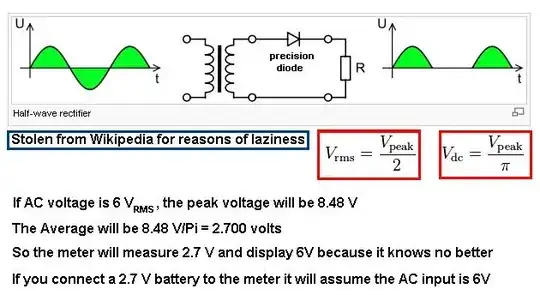
First of all your meter it is not brocken, does not have internal DC blocking for the AC functions, and battery does not have any AC component.
In AC mode your meter runs the voltage input signal through a half wave diode rectifier (just like the old VOM), takes a time average of the result, and then multiplies by a constant factor.
What is this factor? In case that is measure peak and then calculate the RMS the result will be 0.71 times the DC voltage. But in your case it is averages the waveform and multiply by

which is about 2.2 When connect a DC voltage at AC input, the meter does the same thing as for a sine wave, i.e. passes the signal through a diode, multiplies the time average of the result by 2.2, and displays that. But for a DC voltage, passing through a diode (in foreword direction passes quite nicely) does nothing, and the average of a constant voltage is just the voltage itself. So the meter displays 2.2 times the voltage.
You can verify the above doing this: Take a low amplitude sinewave signal from your function generator (namely 5~10V/50~60Hz) and measure with your DMM in AC scale. Next pass this through a diode and measure in DC scale, then multiply by 2.22.
If you want to block the DC component from AC signal, connect a 100nF capacitor in series with the red lead of your multimeter. The capacitor should be rated more than the peak-to-peak voltage you are going to measure. This capacitor in series with your meter input 10MΩ resistance will make a cutoff frequency from 20~30Hz (-3dB). But still you don't have an RMS multimeter as well as you you can't use this meter to read ripple on a DC supply.