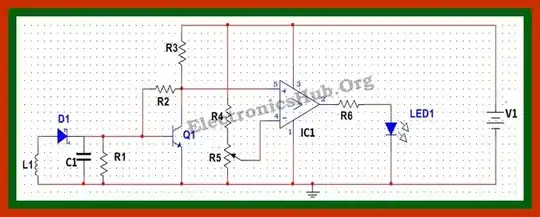
As mentioned in a comment, if a cell phone is completely switched off (or put into "airplane mode"), then there is no way to detect its presence with this circuit.
The circuit above is designed to work at a very short distance from a phone -- we're talking only a couple of inches -- because it is using an inductor to pickup the signal, rather than an antenna. It is suitable for a teacher to use when walking down a row of students to see if any have their phones on, for example. Because of the close proximity, one student's phone is not going to be confused with another.
Even if an antenna was added, and the circuit appropriately modified, there would be no way to usefully extend the range as you suggested to several km, since it has no way of identifying one phone from another.
So even if you could extend the range of the receiver that far, it would simply tell you if there are any cell phones operating within that distance. Maybe useful in the middle of a desert, but that's about it. With such a device equipped with an antenna in a room with several people, you wouldn't be able to tell one phone from another.
Even with a sophisticated receiver, there is no way to determine the identity of a specific cell phone operating over the air. All of the communications between the cell phone and the nearest cell tower are multiplexed with other users in the area, and it would be impossible to identify if your phone was one of them (at least for us mere mortals, without the secret sauce).