How can I calculate voltage and current on each resistor (especially R5) in this circuit? What is its overall resistance? I have no idea how to do this.
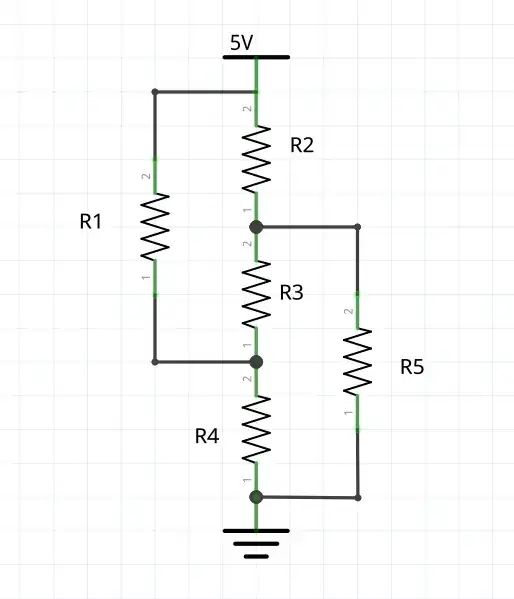
How can I calculate voltage and current on each resistor (especially R5) in this circuit? What is its overall resistance? I have no idea how to do this.


I'd redraw it like this to make it easier to visualize: -

simulate this circuit – Schematic created using CircuitLab
And if you are really lucky and all the resistors are the same value then R3 will pass no current and can be omitted. If not, convert R1 and R4 into a voltage source of 5\$\frac{R4}{R1 + R4}\$ with an output resistance of R1||R4. Do the same for R2 and R5 then you just have a series circuit with no complexity.

You can use the Y-Delta transform. The wikipedia article contains this very same example under the subsection (simplification of networks).
http://en.wikipedia.org/wiki/Y-%CE%94_transform#Simplification_of_networks

This is easy to solve if you break the solution into steps and think Thevenin for each step.
First solve the voltages without R1 and R5. Now model the point between R3 and R4 as a Thevenin equivalent source, and consider the bottom end of R1 as its own Thevenin source. Then connect the two Thevenin sources to find the voltage a the R1, R3, R4 junction.
Given the voltage at that junction, model the R2-R3 junction as a Thevenin source, connect R5 to it, and compute the voltage at the R2, R3, R5 junction.
Now that you have a final value for the R2, R3, R5 junction, go back and compute the final value for the R1, R3, R4 junction. With all the voltages known, you can easily compute the currents.

