I'm trying to build a device similar to railgun. It will have two rails and a conductive movable bar in-between. At one side, I'll provide voltage source and a resistor. If I put it in a strong enough magnetic field, it will move. The idea is that the device will work as demonstration of forces behind an electric motor, so I don't require high speed for the bar.
Here's a sketch:
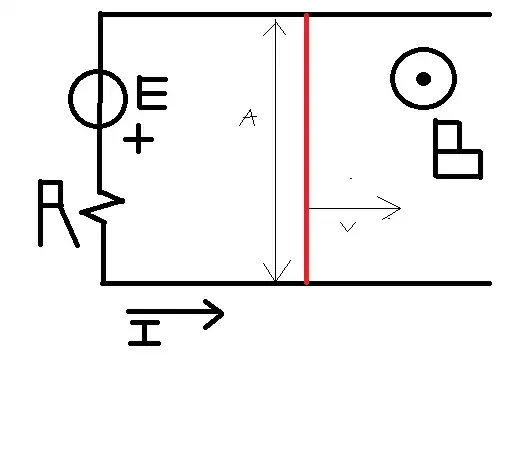
So, I've got voltage source E, resistor R, bar whose length is A and magnetic field B.
If my calculation are correct, force when bar isn't moving should be $F_m=IAB$. I don't require much force, so I guess that 5 mN would be more than enough. The power supply could be a problem. I should be able to get up to 1.3 A without much problems, but anything higher will be problematic, since I can't get a good match between resistor power dissipation and limitations of my power supply.
Since I can't get a perfect constant field, I'm going to have to compromise. I expect the field to drop linearly with A, but on the other hand, force will also get stronger linearly with A, so the differences should cancel themselves out, if I manage to do everything right.
Now about the field source itself. Most obvious sources are natural magnets or electric magnets. I can get natural magnets of various sizes but I don't have their magnetic field strengths. I found several types of magnets in local electronics stores. Their compositions are listed as AlNiCo500, NdFeB and SmCo5, so which one would be a good choice?
Another option would be to make an electrical magnet, but I'm unfamiliar with them, so I don't know where to start.
I'm also open to other means of generating a magnetic field, if I missed some.


