0

I've just been learning about the monostable circuit in electronics and have a question about its function. So, we have this circuit:
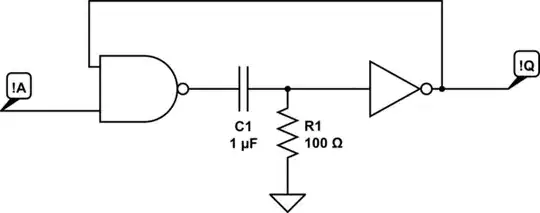
schematic

simulate this circuit – Schematic created using CircuitLab

Now, the capacitor charges to 5V almost instantly when !A is 0. This causes an output of 0 at !Q, which causes the NAND gate to continue outputting a 1. My question is: Why isn't this a stable state? Why doesn't the circuit continue outputting 0 at !Q?

imulsion
  • 1,109
  • 3
  • 12
  • 17
  • This link describes how this circuit works with pretty good detail. Maybe the voltage graphs will help. http://www.electronics-tutorials.ws/sequential/seq_3.html – caveman Jan 11 '15 at 12:28
  • @caveman That's actually really helpful, thank you :) – imulsion Jan 11 '15 at 12:33

2 Answers2

2

No, C1 does NOT charge "instantly" when the output of the first gate goes high (BTW, where are your reference designators for the gates?). Because it is discharged, both ends of C1 go high when the gate goes high, which drives the input of the second gate high and its output low. Since this output is fed back to the first gate, this insures that the output of the first gate remains high.

However, because there is now a voltage across R1, a current begins to flow through it and C1 does start to charge up with a time constant of 1 µF × 100 Ω = 100 µs. As the voltage across C1 increases, the voltage across R1 and at the input of the second gate decreases. Eventually, it decreases enough that the output of the second gate goes high again, which allows the output of the first gate to go low if the other input is also low at that time.

Dave Tweed
  • 172,781
  • 17
  • 234
  • 402
  • OK, I think this is the part I don't understand. Why do both plates of the capacitor go to 5V rather than just the left plate? – imulsion Jan 11 '15 at 12:24
  • The voltage across a capacitor cannot change instantaneously. This is fundamental to how capacitors work. It has to charge and that requires current to flow, which the resistance is limiting. – caveman Jan 11 '15 at 12:25
  • Because the capacitor has no charge initially. Both plates must have the same voltage relative to the rest of the circuit. – Dave Tweed Jan 11 '15 at 12:26
  • I can see how this works now, thank you. Only thing is, why can't the voltage across the capacitor change instantaneously? – imulsion Jan 11 '15 at 12:32
  • It can't change quickly because the resistor limits the current. In general, there's always something that will limit the current, and an instantaneous change would require infinite current. – Dave Tweed Jan 11 '15 at 12:39
  • But what effect does the charge on each plate have on the voltage (we've only just done capacitors and I don't think I understand them fully)? – imulsion Jan 11 '15 at 12:51
  • The charge on each plate controls the voltage between the plates. No charge -> same voltage on each plate. Then that puts 5V across R1 so current flows through R1.That current ... supplies charge to C1 ... increasing voltage across C1 (you've seen the formula Q=C*V, right?) decreasing voltage across R1 (since both voltages sum to 5V at the moment). –  Jan 11 '15 at 13:57
  • @BrianDrummond If there is the same voltage on each plate when it's discharged what causes it to start charging? – imulsion Jan 11 '15 at 14:10
  • The current through R1. –  Jan 12 '15 at 14:37
0

Because even though the initial pulse gets through the cap to switch !Q the 100 ohm resistor to ground soon discharges the other side of the cap back to 0v. (The actual discharge time depends on RC and the switching levels of the gate.) That low voltage then changes !Q back to high again.

Nedd
  • 111
  • 2
  • A simplified answer: For a brief time the cap will look like a short. When the voltage settles the cap looks like an open. – Nedd Jan 11 '15 at 12:37