Are binary adder and parallel adder same thing? I couldn't find any information about parellel adder in my book. Does anybody have an idea?
Asked
Active
Viewed 4.1k times

2 Answers
6
There is a distinction between parallel adder vs serial adder. Both are binary adders, of course, since are used on bit-represented numbers. Parallel adder is a combinatorial circuit (not clocked, does not have any memory and feedback) adding every bit position of the operands in the same time. Thus it is requiring number of bit-adders(full adders + 1 half adder) equal to the number of bits to be added.
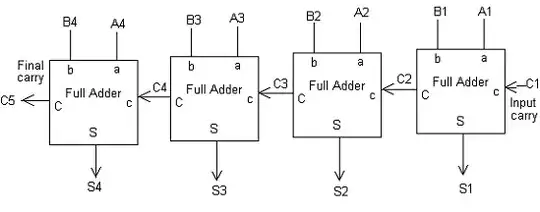
(The image taken from here)
Serial adder is a sequential circuit, consisting of a flip-flop and a full adder. At each clock cycle, it is taking the result of the previous bit addition result carry stored in the flip-flop, calculating the sum result and storing the carry to the flipflop for the next calculation. In this manner, the input data have to be fed serially, synchronized by the clock, and the result is read serially as well.
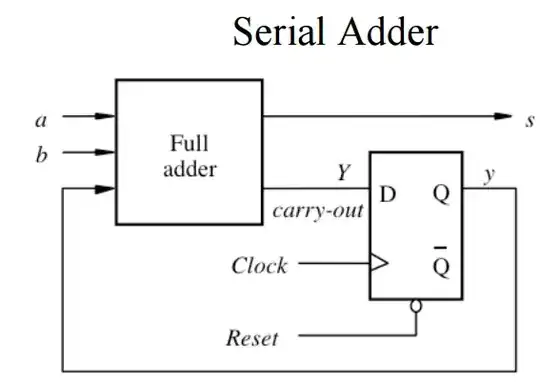
(The image taken from here)

Eugene Sh.
- 10,041
- 2
- 27
- 41
-
Hahaha, we found the same image! OP wasn't asking about Serial Adders, but I guess it's good to mention the difference. – Greg d'Eon Mar 27 '15 at 15:19
-
1
-
Something confused me, in first picture, it is parallel adder right? But I remember in circuits if something connected back to back, they are called serial connection. Am I remembering correct? – berkc Mar 27 '15 at 15:24
-
1Strictly speaking, the result is calculated serially, since the carry is propagating as a "ripple" (this is the official name of such an adder - "carry-ripple"). But the speed of such a circuit (the time between the input is introduced and the valid result) is limited only by the propagation delay of the components. And if used in a clocked circuit, it will require one single clock. So yeah, some confusion may take place here.. – Eugene Sh. Mar 27 '15 at 15:27
-
@EugeneSh. So, difference between serial and parallel adding is serial adding is faster? – berkc Mar 27 '15 at 15:38
-
1The difference is their structure and type (one is combinatorial, the second is sequential. It's a significant difference.) – Eugene Sh. Mar 27 '15 at 15:43
-
@Nick parallel adders are faster than serial adders (as most parallel circuits are faster than serial circuits) this can be shown simply in that serial adders add one bit per clock and parallel adders add one word per clock. serial adders are often cheaper (fewer parts) – hildred Mar 27 '15 at 17:09
1
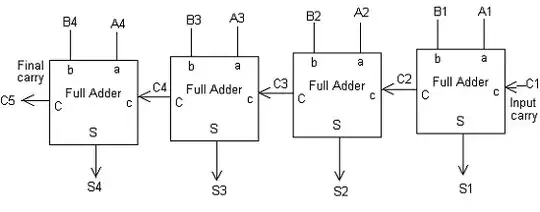
Here is the first result on Google Image Search for Parallel Adder:
and here is one of the first results for Binary Adder:
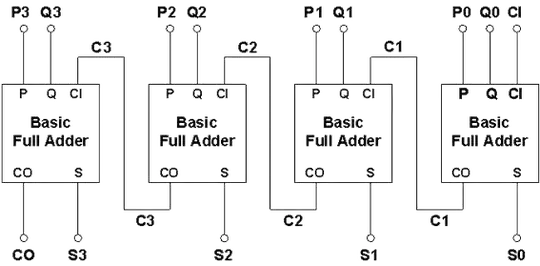
I would say that these are the same.

Greg d'Eon
- 3,827
- 4
- 24
- 50