4

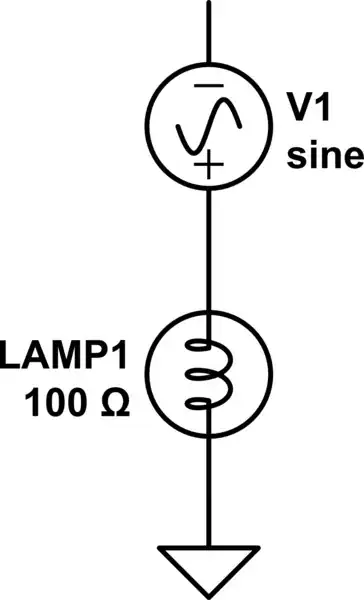
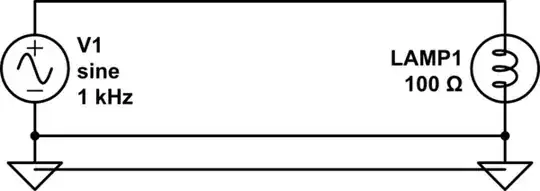
In the first system, will lamp1 turn on?

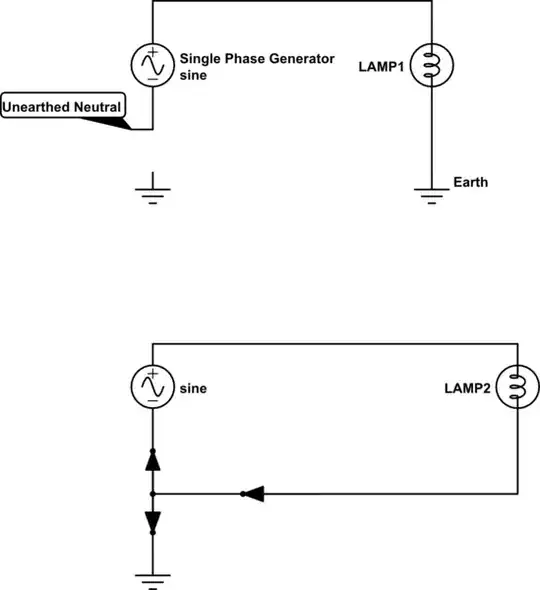
  1. If yes, then why is there no current sharing between neutral and ground as shown in the second system? I always read that neutral is a current carrying conductor but the ground is not. What is the reason behind that? I think current should be shared equally between the two wires of neutral and ground (assuming they have the same resistance).

  2. If no, does that mean earth is not a reference and it does not have "zero" voltage? So there's no need to ground the neutral wire?

Arrows are the direction of currents.

schematic

simulate this circuit – Schematic created using CircuitLab

Peter Mortensen
  • 1,679
  • 3
  • 17
  • 23
Michael George
  • 3,812
  • 14
  • 53
  • 89
  • 1
    "I always read that neutral is a current carrying conductor but the ground is not." Only in normal operation. In a properly grounded system, the ground will act to conduct current as a safety measure in the case of an otherwise potentially lethal misconnection. That is, it will indeed conduct current so that a person does not. – WhatRoughBeast Mar 26 '17 at 13:43
  • 1
    @WhatRoughBeast what you say is true. However, it is only true as a kind of weird consequence of how the folks that designed the system decided to connect neutral to ground at the transformer. Had the system been truly isolated touching the case of an appliance that is shorted to live may give you a little "static like" shock, but it would not kill you. Further, if the case was grounded, the short would not even blow a fuse. – Trevor_G Mar 26 '17 at 15:39

5 Answers5

5

In your first diagram the answer is no. Not because earth is not a reference, but because there is no current return path to the single phase generator.

What happens in the first circuit is the top of the generator is effectively "grounded" through the lamp. The bottom of the generator will show the inverted AC voltage. But since there is no circuit... there is no current. Redrawing it like this helps.

schematic

simulate this circuit – Schematic created using CircuitLab

In circuit 2 there is NO current passing to ground. All the current coming from the AC source MUST return to the AC source.

Current sharing would ONLY occur if you grounded both ends on the bottom schematic. Which is what happens with bad wiring, or if there is a short somewhere. Which is why we install GFCIs in circuit breakers these days.

schematic

simulate this circuit

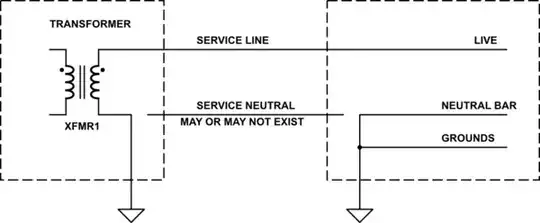
Typically though, houses and especially rural farms are wired this way.

schematic

simulate this circuit

The service neutral line can be omitted to reduce costs. If it DOES exist, and is rated to carry return current from all phases, the neutral should not be connected to the ground at the client end.

Interestingly your schematic #2 brings up an interesting argument: "Would the electrical system actually be safer WITHOUT all this grounding?" If it were a closed loop isolated system, in order to be shocked, you would need to touch Live AND Neutral.

Trevor_G
  • 46,675
  • 8
  • 72
  • 154
  • Omitting the service neutral like that won't work. Dirt is a poor conductor and will not be able to return normal currents. What it will do is raise the voltage of earth around your house/barn, causing a gradient of voltage between house and transformer. That's a big problem if anything carries ground potential some distance, like a grounded tool on an extension cord, fence line, etc. Isolated systems are neat, we had them before we grounded stuff. Not that neat, apparently. – Harper - Reinstate Monica Mar 26 '17 at 19:11
  • @Harper, they do that all time round here in rural areas. Though the farmers do complain it affects the cattle milk production. – Trevor_G Mar 26 '17 at 19:42
  • LOL I bet it does! Is this Australia? They're real into that, but current is low. I think of isolated systems as "the first ground-fault is free". It simply becomes the ground bond. Having been through that, it's a lot less fun than it sounds. It works best if you have active maintenance staff who routinely check for ground faults. We do that on 480-delta systems. – Harper - Reinstate Monica Mar 26 '17 at 19:51
  • 1
    @Harper Canada here, same long distances. You are right dirt is not a great conductor, but when its a couple thousand mile thick (downwards) it doesn't matter much. – Trevor_G Mar 26 '17 at 20:10
3

Your first circuit won't work since there is no closed conduction loop path.

Your second circuit, minus the diodes or whatever those arrows are, is how power systems in single houses work. The neutral is tied to earth ground in one place, usually close to where the power comes into the house.

Earth is not "0 Volts" or anything else since voltage is a relative concept. You would have to explain 0 Volts to where? Since the earth is a large and pervasive conductor and many things are electrically tied to it, even if not deliberately, it is common to consider it the 0 Volt reference to measure other voltages relative to.

Olin Lathrop
  • 313,258
  • 36
  • 434
  • 925
3

You may be confusing two different things:

  • Ground in an electronics context, as in Vss, as in the normal current return.

  • Earthing, aka Equipment Safety Grounding in a mains-electrical context, which is entirely a safety shield around what is effectively an isolated system of hot and neutral, with neutral being the usual current return.

There is never any current on Safety Ground except during a wiring fault. If the fault current is excessive, it will trip the circuit breaker. If not, it will hopefully flow enough to induce a GFCI trip, and not hurt any humans.

In mains wiring, conductors (hot and neutral) should be connected to Safety Ground absolutely never, with a solitary exception made out of necessity: an isolated system has nothing to keep the conductors from attaining an unexpected voltage. For instance leakage in a supply transformer could bias the entire isolated system at 2400V above ground, which would fail insulation. Or the isolated-system voltage could "rattle" due to capacitive coupling. So to prevent floating, the conductors are pegged to the earthing system, and the bonded conductor is defined as "neutral".

This neutral-ground bond is done in one single place to prevent redundant current paths (which themselves would be considered a ground fault). Before it was just good practice; now GFCI/RCD and AFCI protection devices absolutely require it.

Your first diagram is correct on the left and a code violation on the right: you didn't wire a neutral so you bootlegged neutral from ground. It will light only if somewhere off-diagram there is a neutral-ground bond. However if the source is GFCI/RCD protected, it will trip instantly.

Your second diagram shows an ungrounded system, much like you might have had in a 1946 house, except with the aforementioned neutral-ground bonding present. By modern standards you would want to extend that safety ground out to the loads, though GFCI/RCD protection will protect people if present.
1
  1. No to this one
  2. Earth is a reference for zero volts and neutral is (usually) connected at one point to earth. This ensures that any current that flows through the live wire but not the neutral can be detected by an RCD and save lives.

In the US, an RCD is called a GFCI.

If you don't ground the neutral wire then there is no means to detect if an unsafe single fault appears and RCDs won't work.

Andy aka
  • 456,226
  • 28
  • 367
  • 807
  • 1
    Neutral wire does not need to be grounded for GFCI to work. It uses live and neutral though a counter-wound transformer. Matched currents don't excite the ransformer. Any imbalance in live and neutral currents implies some is going to ground somewhere. – Neil_UK Mar 26 '17 at 13:29
  • @Neil_UK, or somewhere else.. Cross phase, a different neutral line.
  • – Trevor_G Mar 26 '17 at 13:30
  • @Neil_UK if neutral isn't grounded then there is no fault current to earth because the circuit is isolated. – Andy aka Mar 26 '17 at 13:32
  • @Neil_UK, though specifically, Neutral does not need to be grounded in the house.. but it does need to be grounded somewhere, e.g. at the distribution transformer. – Trevor_G Mar 26 '17 at 13:33
  • I meant in the house, it was taken as read that it's grounded somewhere – Neil_UK Mar 26 '17 at 14:10