2

Hi I'm having a really bad time in analyzing this circuit
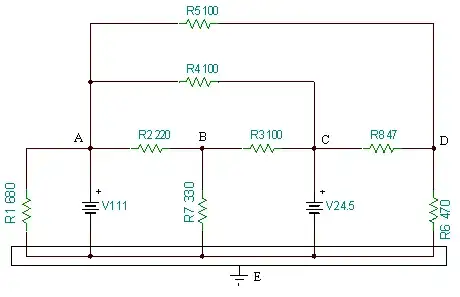
I can't seem to establish the node equations, I've been reading on articles on how to solve it but the majority use current sources and the methods differ quite a bit, any help is really appreciated.

I know that I have to use KCL on each node, for example for node B I said:

\$ I_{1}+ I_{2} - I_{3} = 0 \$

\$ I_{1} = \dfrac{A-B}{220} \$
\$ I_{2} = \dfrac{C-B}{100} \$
\$ I_{3} = \dfrac{B}{330} \$

Given that and solving for B

A = 12 v
C = 4.5 v

\$ \dfrac{A-B}{220} + \dfrac{C-B}{100} - \dfrac{B}{330} = 0 \$

\$ \dfrac{A}{220} - \dfrac{B}{220} + \dfrac{C}{100} - \dfrac{B}{100} - \dfrac{B}{330} = 0 \$

\$ \dfrac{A}{220} + \dfrac{C}{100} - B ( \dfrac{1}{220} + \dfrac{1}{100} + \dfrac{1}{330}) = 0 \$

\$ \dfrac{A}{220} + \dfrac{C}{100} = \dfrac{B}{\dfrac{1}{220} + \dfrac{1}{100} + \dfrac{1}{330}} \$

B = 650( A/220 + C/100 )

Substituting A=12, C=4.5

\$ B = \dfrac{ \dfrac{A}{220} + \dfrac{C}{100 } }{ \left( \dfrac{1}{200} + \dfrac{1}{330} + \dfrac{1}{100} \right) } \$

B = 5.66 v

because of independent voltage sources.

I know my problem is on establishing the equations as I don't fully grasp how the analysis is made.

PeterJ
  • 17,201
  • 37
  • 57
  • 91
Tristian
  • 191
  • 1
  • 10

2 Answers2

2

Your equations for I1, I2 and I3 are OK, and when you replace A and C with their resp. voltages, you have only 1 variable left: B. Filling in the equations in

\$I1 + I2 - I3 = 0\$

gives you a single linear equation in one variable, which you no doubt can solve. The calculation for D is exactly the same: there's a resistor from A, one from C and one to ground.

stevenvh
  • 145,832
  • 21
  • 457
  • 668
0

In general you not only have to apply KCL but also KVL.

KCL gives you an equation for each node (A, B, C, D, E). The sum of currents in each node is 0
KVL gives you an equation for each loop. The sum of voltages in each loop is zero.

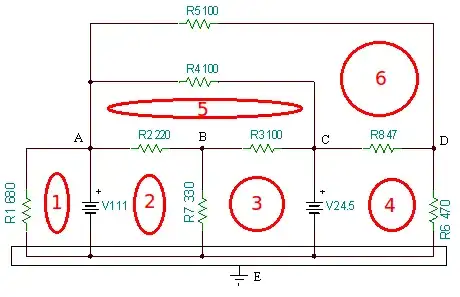
Some of the loops are (see added picture):

  1. R1 V1
  2. V1 R2 R7
  3. R7 R3 V2
  4. V2 R8 R6
  5. R2 R3 R4
  6. R4 R5 R8

enter image description here

All equations together result in an simultaneous linear equation system for all your currents and all your voltages.

You can solve the linear equation system e.g. by Gaussian Elimination.

Curd
  • 16,283
  • 35
  • 46
  • What exactly do you mean by "loop"? – Tristian Apr 27 '12 at 08:24
  • 1
    You can perfectly solve this with only KCL. See my answer. – stevenvh Apr 27 '12 at 08:30
  • That is what I did initially, but as my above comment suggests I think that the value is way off. – Tristian Apr 27 '12 at 08:35
  • Thanks for taking the time to edit the image, clears the "loop" question.. – Tristian Apr 27 '12 at 08:39
  • You're unnecessarily complicating things! OP can easily solve this when he combines his equations into his first. – Federico Russo Apr 27 '12 at 08:51
  • @stevenvh and Federico Russo: KCL might be enough for this case, but I think it is not complicating things because this works always: (1) set up equations for all nodes and loops. (2) Solve equation system. (3) Get values for all voltages and currents. – Curd Apr 27 '12 at 08:58
  • Solving a set of at least 6 simultaneous equations using Gauss is always more complicated than solving a single linear equation. – stevenvh Apr 27 '12 at 09:00
  • 1
    @stevenvh: I agree totally for this particular case, but the other approach works in general, no matter how the circuit is connected. Solving it that way is so mechanical that it can be implemented easily in an algorithm. And I think being aware that solving ANY circuit containing only resistors, current and voltage sources (plus L and C if you use complex numbers) is equivalent to solving a set of linear equations is very valuable. – Curd Apr 27 '12 at 09:10