I'm wondering why the node voltage of C will equal to
Vc = Vd + 770
I've done research but have no clue. Any help will be appreciated.
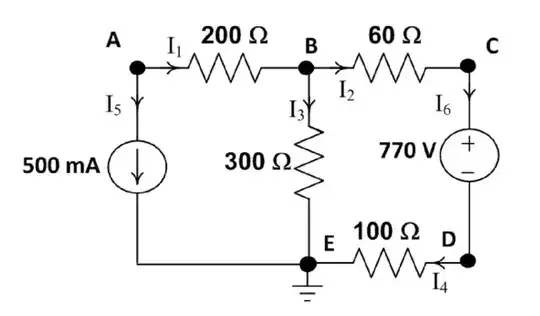
I'm wondering why the node voltage of C will equal to
Vc = Vd + 770
I've done research but have no clue. Any help will be appreciated.
Since voltage 770 V is defined as the potential between C and D nodes, you can rewrite it:
Vc - Vd = 770V
Vc = 770V + Vd
Vd will never be 0 because it is not directly tied to ground (or reference terminal). There is a resistor of 100 ohm between D and reference, and thus it will be a voltage drop Vd defined as:
Vd = I4 · 100 ohm
Well, using Ve as reference (Ve=0) then, in the node D the voltage is Vde=Vd-Ve = Vd-0 = Vd and the voltage in the node C is Vcd=Vc-Vd = 770 therefore Vc=770 + Vd

Not sure if this helps, but if you do this:-

it results in this:-

with the notable value of -200V at node D. This is one of those freak values due to the constant current source I1. Whilst all the other components are considered as passive, a constant current source is an active component and quite often plays havoc with my simulations.


