First, your Ohm's Law equation is calculating what is called 'peak power,' which uses the maximum voltage output of the amplifier. Another common way to specify power ratings on speakers is 'RMS power,' which calculates the equivalent heating of a DC source as your AC source (i.e. the amplifier). RMS power of your setup would be:
$$P_{RMS} = V_{RMS}^2 / Z_{speaker} = \frac{V_{peak}^2}{2} / Z_{speaker}$$
So in your case, the \$3 V_{peak}\$ amplitude reduces to \$2.12 V_{RMS}\$ You'll need the datasheet of your speaker to determine whether the 0.5 W rating is in peak or RMS power.
But that's not the whole story, because \$Z_{speaker}\$ is certainly more than just a DC resistance. Alluding to this previous question, the speaker is modeled as a combination of DC resistance with a significant inductance in series, plus some parasitic components:
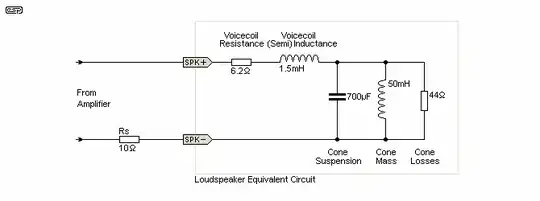
(Note that Andy's answer's link has moved here as of this posting.) Recall that the impedance of an inductor increases as frequency increases:
$$Z_{inductor} = j \omega L = j 2 \pi f L $$
So the speaker's impedance will also vary with frequency. From my experience, speaker impedance is often rated at 1 kHz or thereabouts, so your speaker's impedance at 500 Hz may be lower and thus more power may be delivered than you'd calculate by using the static \$8 \Omega\$ value.
There is also the question of your amplifier's output impedance. If you see \$3 V_{peak}\$ with the amplifier unloaded, even \$1 \Omega\$ of output impedance (a very fine amplifier indeed) will reduce the voltage across the speaker to \$1.88 V_{RMS}\$ and thus reduce the power delivered to the speaker.
My suggestion: observe the voltage across the speaker and listen for any distortion, which is a good indication of over-driving. And examine the datasheet if you have it.


