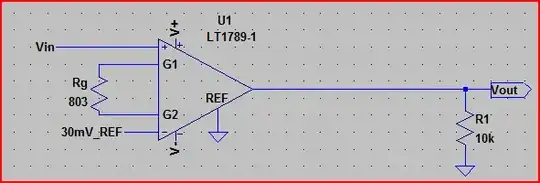
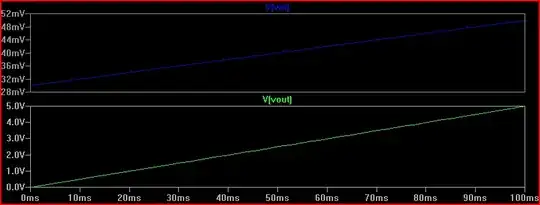
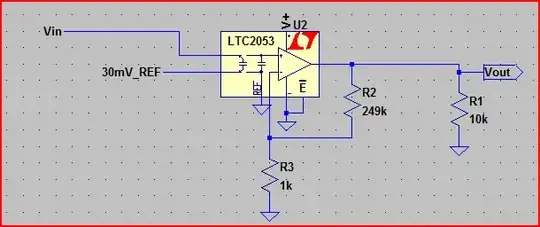
You can use a differential amplifier to subtract the 30 mV offset.
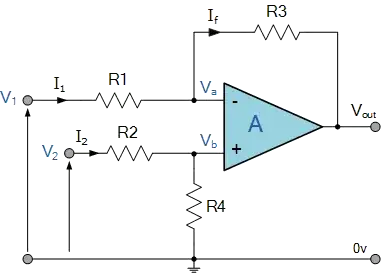
When R1 = R2 and R3 = R4 the transfer function is
\$ V_{OUT} = \dfrac{R3}{R1}(V_2 - V_1) \$
So set V1 to 30 mV and choose R3 = 250 \$\times \$ R1.
A problem with differential amplifiers is that R1 will load the resistor divider to get the 30 mV offset, so that you have to recalculate the resistors, and also V2 will have an input impedance which may distort the measurement.
An instrumentation amplifier is the solution.
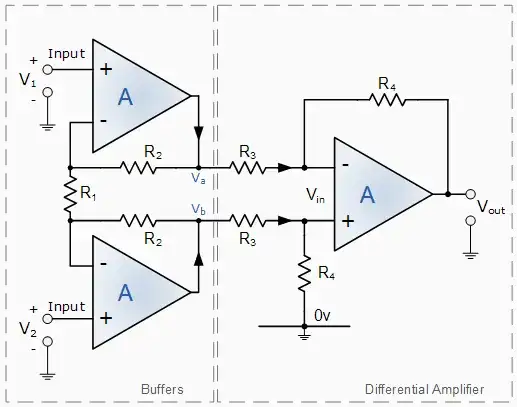
Most instrumentation amplifiers are differential amplifiers with a buffering input stage. The input stage sets the gain, while the differential stage is usually a \$\times\$1 amplifier. The amplification is then
\$ V_{OUT} = \dfrac{2 R2}{R1}\cdot \dfrac{R4}{R3} (V_2 - V_1) \$
The Microchip MCP6N11 is a suitable device.