2

This might sound like a dumb question but I just learned about buffers and learned that they have same Vin and Vout from the amplifier providing nearly identical Voltage source value to the next op amp or sensor. But I don't understand why we use this in the first place.

If you want to amplify your signal in the first place why don't you directly hook up a non inverting or inverting amplifier to directly amplify the signal right away?

Why do you have to put a buffer and then pass down your signal to the next opamp to amplify signal? Wouldn't it make more sense to directly use the non buffer amp hooked to a source that you want to measure and directly amplify the signal?

CuriousJ
  • 93
  • 2
  • 8

5 Answers5

6

There are several ways to "amplify" a signal, not only its amplitude is important. Buffers essentially amplify "current", or "input power". They typically have a very high input impedance and low input capacitance, so they don't load much the signal source even at high frequencies. At the same time they have a fairly low output impedance (typical target is 50 Ohms), so they can drive coaxial cables and "deliver" the signal over fair distances without distortions, like in "active" oscilloscope probes. This the the main purpose of "buffers".

Ale..chenski
  • 40,470
  • 3
  • 39
  • 109
3

Why do you have to put a buffer and then pass down your signal to the next opamp to amplify signal? Wouldn't it make more sense to directly use the non buffer amp hooked to a source that you want to measure and directly amplify the signal?

You don't have to, sometimes. But there are other times when you do. It depends how you want to process the signal.

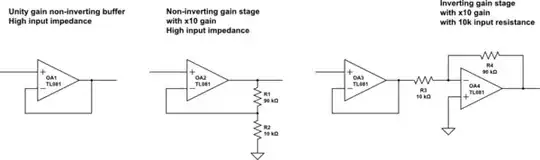
Let's say you have a source you don't want to load at all, so you'd need a high input impedance to your amplifier. If you're happy for the amplifier to have non-inverting gain, then you can build it with gain, and still have a high input impedance. If you want inverting gain, let's say you want to add several signals together, then an inverting gain stage has a low input impedance, and you'd need to precede it with a buffer stage.

schematic

simulate this circuit – Schematic created using CircuitLab

Neil_UK
  • 166,079
  • 3
  • 185
  • 408
2

A buffer is a form of servo control. The input to the buffer is designed so that it consumes very little power, thus making life easier for the op-amp which provides the input signal. But the output is capable of delivering lots of power to the downstream load, even if the load is difficult due to low impedance or frequency-dependent impedance. It may not change the voltage, but it protects the signal source from feeling the impedance presented by the load.

It is similar to power steering or power brakes in a car. You still control the car with the steering wheel and brake, but the power assist makes it easier to move the control.

user57037
  • 29,324
  • 1
  • 30
  • 85
  • I'm not sure the analogy is correct. Power steering is a form of muscle amplifier. So are hydraulic brakes. They amplify muscle "power". –  Feb 17 '19 at 06:24
  • Yeah and I probably used servo incorrectly. Apparently only mechanical systems can be "servo-mechanism". But the point I was trying to make is that with or without power steering, the wheel would be manipulated into the same location to control the car. It would just be more difficult. So in my mind, voltage is like wheel position, and effort is like current output of the buffer. – user57037 Feb 17 '19 at 06:40
0

Amplifiers serve many functions; making a signal larger, or smaller, or changing from low impedance to high impedance, or from high impedance (current source) to low impedance (voltage source).

One useful function of a buffer (voltage gain of 1) amplifier is to prevent interfering signals at stage 2 from propogating to stage 1 of a signal-processing chain. So, a buffer between a source and a long wire connection will serve to prevent antenna-like pickup on the wire from disturbing the source. Buffer outputs can be safely probed without disturbing device operation. A buffer output can drive a shield to minimize or null stray capacitive currents.
One might use a buffer before an element that has multiple states (like, low-power sleep mode) to protect the signal from being corrupted by the dead element, or during power transitions, or to prevent the signal from powering-up circuitry intended to be inert.

Another useful function is to limit the signal; a buffer can deliver output that is guaranteed to be within a known range (voltage, current, slew rate limits) for input to low-speed, low-voltage, or logic elements that are intolerant of some potential signal characteristics.

Finally, integrating power output onto an operational amplifier chip runs a risk of thermal feedback effects; a buffer amplifier with heatsinking can be the perfect output stage, thermally distant from the sensitive input pins of the first-stage amplifier.

Whit3rd
  • 7,568
  • 22
  • 27
0

Buffers used right after an opamp, and used within the feedback loop, are a way to minimize the THERMAL DISTORTION of the signal chain as contributed by the opamp.

For DC to 1,000Hz audio signals, and particularly for 100Hz signals that have onchip (in the silicon) propagation-delays THRU THE SILICON as heat, that couple from the hot output transistors to the input differential-pairs, you as signal-integrity designer need to evaluate the intermodulation between low-frequency and high-frequency tones in audio. And in high-precision measurements, the settling-time will be degraded by thermal tails.

analogsystemsrf
  • 34,253
  • 2
  • 19
  • 48