0

There is a lot of talk about GaN circuits making chargers more powerful at the same size as traditional silicon-based chargers. But are there any benefits if the goal is to minimize size and weight with the some power, or do the advantages of GaN manifest only with higher power flows? Does this concern powerbanks, where this is also claimed.

1) I.e. let's say I have a charger outputting 18 W through USB-C PD or some equivalent USB-A. Something like this: https://www.axagon.eu/en/produkty/acu-pq22 weighting 62 g. How much would one expect to save from using GaN components?

2) Or let's say a typical powerbank at 20 000 mAh, input and output at 15 W, 3 A at 5 V as per USB-C PD, weighting around 360 g, like this: https://www.anker.com/products/variant/powercore-speed-20000-pd/B1275011 How much (if anything at all) decrese in size and weight can one expect from GaN components?

I hike a lot so weight is probably the most important consideration. I would like to know if I can expect any improvements in this area from GaN components. Of course, higher power is a nice bonus but if having to choose between lower weight and higher power, I would always go fo lighter weight.

sup
  • 117
  • 5
  • 5
    Especially for the powerbank, it is utterly irrelevant. Almost all the weight there is battery. –  Feb 08 '20 at 15:14
  • There is a lot of talk about GaN circuits making chargers more powerful at the same size as traditional silicon-based chargers Where, how? Include a link. My feeling is that you're relating this to USB power banks while the statement relates to for example chargers for electric cars. There are benefits to be had there (higher efficiency, less cooling needed) but not in USB power banks. There's not much that can be gained from using different technologies in a modern powerbank. Their main limitation is in their batteries, not the electronics. – Bimpelrekkie Feb 08 '20 at 16:38
  • @Bimpelrekkie For example here: https://www.theverge.com/circuitbreaker/2019/1/30/18203879/gan-chargers-anker-powerport-atom-pd-1-ravpower-45w "GaN chargers are physically smaller than current chargers. This is because gallium nitride chargers don’t require as many components as silicon chargers. The material is able to conduct far higher voltages over time than silicon." – sup Feb 08 '20 at 21:08
  • And "GaN chargers are not only more efficient at transferring current, but this also means less energy is lost to heat. So, more energy goes to whatever you’re trying to charge. When components are more efficient at passing energy to your devices, you generally require less of them." – sup Feb 08 '20 at 21:09
  • 4
    I wouldn't rely too much on theverge as a site for in-depth detailed technical information. They write as if the complete electronics in the charger (not a power bank!) will be GaN. That's not what GaN is used for, GaN is generally used for the switching transistor only as that needs to be fast switching and able to withstand high voltage. – Bimpelrekkie Feb 08 '20 at 21:46
  • 3
    The material is able to conduct far higher voltages over time than silicon. Again clearly written by someone who has no clue, a 400 V "traditional" transistor or a GaN transistor can both withstand 400 V. The advantage of GaN is in the way that the transistor is controlled (can be easier than a traditional MOSFET) and/or efficiency (due to faster switching). There is no "conducting higher voltages" that sentence just doesn't make sense. If you want proper technical information, go to engineering sites, not "the verge". They're only OK for general info. – Bimpelrekkie Feb 08 '20 at 21:48

2 Answers2

2

It’s not the case that you make a new charger by filling some internal component full of GaN to replace the old silicon tech; there are probably only two components amongst maybe 30 or so that can be changed from silicon to GaN and these might weigh a few grams at most.

And, it’s likely that those components will remain inside the same physical package or, at best slightly smaller.

The biggest mass inside chargers is likely the flyback transformer and this dominates matters. It won’t change weight or dimensions with the arrival of GaN so sorry, I don’t think you are going to see anything other than the odd gram of weight loss.

Andy aka
  • 456,226
  • 28
  • 367
  • 807
  • So the statement from here: https://www.androidcentral.com/zendures-supermini-10000mah-battery-pack-adorable-and-powerful-and-under-35 "The diminutive battery is significantly smaller than the average pack, in part because of its use of GaN (gallium nitride) instead of traditional silicon to produce the components, which allows the components to take up far less space, leaving only the battery cells itself." Is rubbish? Their 10 AH powerbank at 180 grams is lighter than the competition, even if it is just 10 grams or so. – sup Feb 08 '20 at 21:12
  • 3
    How many ads tell the truth? – Andy aka Feb 08 '20 at 21:16
  • This answer displays a lack of understanding towards the reasons for using GaN, as well as how to reduce physical component sizes. GaN allows you to switch much faster than silicon while maintaining acceptable efficiency. Faster switching means you need to store less energy per cycle, reducing the size of capacitors and magnetics. – W5VO Feb 09 '20 at 16:40
1

1) I.e. let's say I have a charger outputting 18 W through USB-C PD or some equivalent USB-A. Something like this: https://www.axagon.eu/en/produkty/acu-pq22 weighting 62 g. How much would one expect to save from using GaN components?

The Apple iPhone 5W charger weighs 23g and has a power efficiency of ~75%. If power dissipation was the only factor then an 18W charger using more efficient components could theoretically be made the same size and weight, if it was 91.5% efficient (producing 3.6 x higher output power for the same loss). This efficiency might be achievable with GaN, but would it actually make the device that much smaller and lighter?

Power dissipation capability is mostly determined by surface area which is proportional to linear size squared, while volume and weight are proportional to linear size cubed. However the power handling capability of transformers and capacitors is more closely related to volume and weight because their electrostatic or magnetic storage capacity is determined by the amount of active material in them. Therefore a 91.5% efficient design could reduce the weight of some of these components by up to 20% because the input power is 20% less than in a 75% efficient charger.

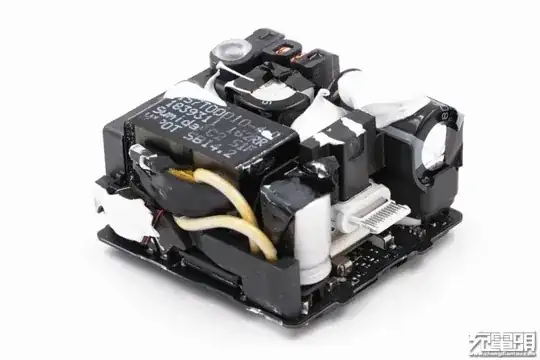
Looking inside an Apple 18W charger we see that the largest components are the transformer and filter capacitors. Electrolytic capacitors are bulky but very light, so the main weight savings would be in the transformer, with perhaps some more in the PCB and case (assuming they can also be made smaller). But some other parts such as the mains plug and USB connectors cannot be reduced, so the overall weight savings would probably be less than 20%. If we assume a 15% weight saving then an 18W GaN based charger could be 10 g lighter than a 'conventional' design, ie. 52 g instead of 62 g.
enter image description here

2) Or let's say a typical powerbank at 20 000 mAh, input and output at 15 W, 3 A at 5 V as per USB-C PD, weighting around 360 g, like this: https://www.anker.com/products/variant/powercore-speed-20000-pd/B1275011 How much (if anything at all) decrese in size and weight can one expect from GaN components?

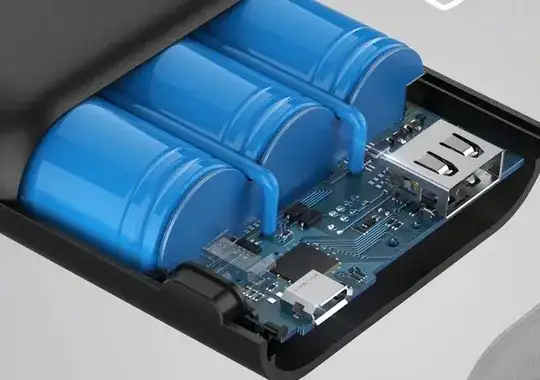
Here the weight savings could closely relate to increased converter efficiency because battery capacity is directly proportional to weight. However the efficiency of a 'conventional' converter can more easily exceed 90% at relatively small boost ratios (eg. 3.7V to 5V) than a mains converter which has to reduce voltage by a ratio of ~25-50:1. With higher initial efficiencies GaN devices do not offer as much advantage, so the savings are likely to be less. In a typical powerbank the electronics already only take up a small part of the case volume, so the possible size saving is also limited.

As to your link, the review is light on facts and makes dubious claims. The device is purported to be smaller "in part because of its use of GaN", but also because "the two separate 5,000mAh batteries... save space inside the chassis by stacking them on top of one another" which doesn't make any sense since total battery volume is the same no matter how they are placed.

Curiously the Anker PowerCore 10000 has similar dimensions, yet no mention is made of GaN technology. Looking at the opened case view it seems like they could have made it even smaller!
enter image description here

Bruce Abbott
  • 56,322
  • 1
  • 48
  • 93
  • Thank you for the image of the powerbank. I always assumed most of the circuitry from a charger is replicated there, but now I can see that it is not the case. – sup Feb 10 '20 at 14:22