0

As discussed earlier, terminal voltages would never exceed the CV value (4.2V for Li-Ion cell) while charging:
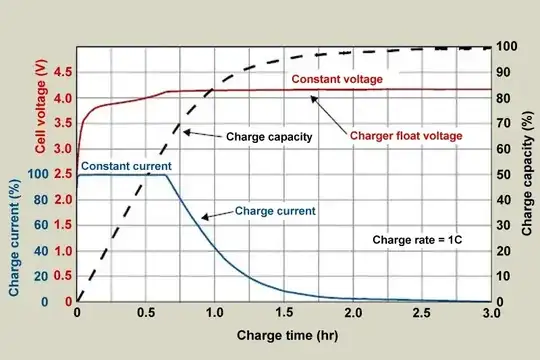
charge

If that's the case, the CC value should be the current value at the time the terminal voltages just reached to the CV value.

Could we precisely determine the exact "Constant Current" value (the Current Limit value, actually) of a given Lithium battery by the following procedure:

  1. Determine the battery chemistry to determine the CV value (eg. Li-Ion battery, 4.2V/cell)
  2. Use its capacity value (or make a safe assumption) and use 0.5C to start charging.
  3. At the moment the terminal voltage of the battery is just reached to the CV value (4.2V for Li-Ion), increase current limit of the power supply to the point that the actually drawn current is not increasing anymore.
  4. The actual current at this moment is the CC value.
  5. To fine tune this determined CC value, repeat the steps from #2 for one or two more times.

Is above procedure correct for determining the exact practical CC value of any Lithium (based) battery?

Rationale

In order to safely use any Lithium Ion (or LiFePO4) battery for a custom application (device), charging characteristics should be determined if it is undocumented (like a cell phone battery).

If this is an appropriate procedure, then we could verify a battery follows its datasheet specs.

ceremcem
  • 1,426
  • 18
  • 38
  • 2
    Read the datasheet. The manufacturer will tell you what the safe charging current limit should be. – Elliot Alderson Mar 14 '20 at 23:37
  • There is no empirical way to determine it. For crappy small pouch cells I would say C/3 or C/4 is a good number. But for rapid discharge cells, charging at C is often OK as long as you confirm that the cell temp is within a certain range (not too hot and not too cold). So, read the datasheet. – user57037 Mar 15 '20 at 00:12
  • What does step 3 mean. At the point the terminal voltage is equal to the CV value any increase in in current will cause an increase in terminal voltage. – Kevin White Mar 15 '20 at 01:01
  • @ElliotAlderson Let's slightly change the question: Shouldn't the actual charge current stay under CC value (which is declared in the datasheet) when we increased the current limit to a ridiculously high value at the moment the terminal voltage is just reached the CV voltage? – ceremcem Mar 15 '20 at 01:21
  • @KevinWhite We are not increasing the current, we increase the current limit. (consider a lab power supply with current limit function. Let's say we limited the supply to 1A for normal charging procedure. When the terminal voltage rises from 4.19V to 4.20V, increasing the current limit from 1A to 100A wouldn't increase the current actually drawn by the battery) – ceremcem Mar 15 '20 at 01:23
  • @ceremcem - Then what is the point - it doesn't;t tell you anything. Your result will always be the CC limit you guessed at. The charging current is not a fixed value anyway it depends upon the compromise of battery life, battery history, charging time and temperature that you want to live with. EV battery charging does dynamically take those factors into account. – Kevin White Mar 15 '20 at 01:45
  • @KevinWhite If the practically determined current is equal to the value on the datasheet, then we simply verify it. If we don't know the actual CC value of the battery and my procedure is correct, then we can use a safest possible current to start charging the battery (C/20, C/30, for example), then at step 3 we find out the exact CC value. Probably we need to take the temperature into account. On the other hand, I don't know anything about battery history/remaining lifespan and charging characteristics correlation. This procedure might reveal the health status of the battery then? – ceremcem Mar 15 '20 at 01:51
  • What do you mean "we increased the current limit to a ridiculously high value"? The current limit from the datasheet is the current limit, full stop. It does not change when we reach the voltage limit (what you call the CV value). You must respect the limits given in the datasheet. – Elliot Alderson Mar 15 '20 at 03:01
  • I explained what I meant by "increasing the current limit" 3 times by now. Let's make it 4 by an example: Consider a Lithium battery with a datasheet that declares the constant charge current as 1A and constant voltage as 4.2V. A fully discharged battery would draw - eg. - 13A if you simply apply 4.2V with 20A current limit. So you have to limit the current to 1A. When the terminal voltage reaches to 4.2V as the battery charges, drawn current will slowly drop as the chart states. At this point, rising the current limit to 20A would make no effect on drawn current. (20A=Ridiculously high value) – ceremcem Mar 15 '20 at 03:28
  • Step 3 is too late to change the current limit. Nothing will ever happen except the voltage will stay at 4.2 and the current will follow a normal taper. The moment the supply transitions from CC to CV, you will never be able to increase the charge current unless you increase the voltage above 4.2 (or whatever voltage you are using for CV transition). – user57037 Mar 15 '20 at 05:58
  • @ceremcem - you need to explain in more detail what you do at step 3 - to me and other posters it doesn't seem that it will do anything. – Kevin White Mar 15 '20 at 18:21
  • @KevinWhite At this point I think I must grab a brand new Lithium Ion battery with a datasheet and conduct a proper experiment of this one. – ceremcem Mar 15 '20 at 18:29

2 Answers2

1

At the moment the terminal voltage of the battery is just reached to the CV value (4.2V for Li-Ion), increase current limit of the power supply to the point that the actually drawn current is not increasing anymore.

At this point the battery has reached maximum voltage and current is already throttling back from the previously set limit, so raising the current limit will make no difference. So no, it wouldn't work.

What could work is watching the rate of voltage rise earlier in the charging cycle, and adjusting the current until the voltage rises at the expected rate for that part of the cycle. Now the only problem is, what is the expected rate of voltage rise? If the battery is rated for charging at 1C then it should reach 4.2V per cell in about 40 minutes, and you could adjust the charge current to match the curve in your graph.

However an old battery (with higher resistance) or high capacity battery (rated for lower charging current) should take longer, and that would have to be taken into account. Perhaps the charger could measure the battery's internal resistance, and adjust the charge current to suit.

Today I charged an old high capacity Lipo battery that had not been recharged in over 2 years (it gets used infrequently at a low discharge rate). The battery had no markings to tell me what rate to charge it at, but knowing that it is designed for a low rate I started at 0.5C. The voltage climbed up to 4.2V in a few minutes, which indicated that the current was too high. After cutting back to 0.1C the voltage finally settled down to what I was expecting. If my charger did that automatically I might think it was faulty! But that is the correct charge rate for this old high capacity battery.

Bruce Abbott
  • 56,322
  • 1
  • 48
  • 93
0

No. For one, there's no physical reason to think that the safe charging current at 0% charge bears any specific relationship to how much current you can push at, say, 70% charge without exceeding the CV threshold.

For another, your procedure is basically a tautology. If you pick some value of current for the CC phase, wait until you hit the CV threshold, and then try to measure how much current the battery can accept at that point, the answer you get is going to be whatever current you picked to start with. If you start off at a lower current, the terminal voltage won't rise as much, you'll get to a higher state-of-charge in step 3, and you'll conclude that the current the battery can accept is lower. If you start off at a higher current, the terminal voltage will rise more, you'll get to step 3 at a lower state of charge, and you'll conclude that the battery can accept more current. You're not measuring anything except a quantity that you already decided the value of.

hobbs
  • 7,397
  • 1
  • 20
  • 31
  • "For another, your procedure is basically a tautology. If you pick some value of current for the CC phase, wait until you hit the CV threshold, and then try to measure how much current the battery can accept at that point, the answer you get is going to be whatever current you picked to start with." You are skipping the step that we are pushing the current limit to a very high value before we measure how much current the battery accepts. – ceremcem Mar 15 '20 at 03:41
  • @ceremcem I'm skipping the step that, by your own admission, does absolutely nothing at all? It makes no difference what you set the current limit to, once you've reached the point where you're not current-limited! – hobbs Mar 15 '20 at 03:57