How is IR rays that have carrier frequency of ~1014 Hz generated by GaAs in remote control carried over carrier frequency of 34Khz to the sensor?
Asked
Active
Viewed 1.6k times


3 Answers
21
There are two different frequencies, in two entirely different contexts, involved.
The infrared light generated by an infrared LED is in the 300+ GHz range, this is correct. For instance, the TSAL5400 IR LED often used in remotes has its radiation peak at 940nm wavelength, i.e. 318,930 GHz.

However, IR remote controls do not output continuous infrared light. The LED output is "chopped" via control circuitry into pulses of a given frequency, such as 34 KHz, 38 KHz, 40 KHz or 56 KHz.
The IR sensor at the other end filters incident IR at the specified frequency, and ignores any IR that does not conform to this chopping frequency or modulation. This ensures that stray infrared light, such as from sunlight, heat sources, or incandescent lamps, is ignored by the sensor, and only the correctly modulated incoming IR is acted upon.
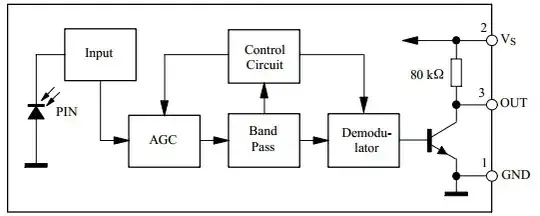
This block diagram illustrates the operation of the classic, and now obsolete, TSOP17xx family of IR receivers, with the bandpass stage shown. This part, for instance, offers the following versions by chopping frequency:
- TSOP1730 30 kHz
- TSOP1733 33 kHz
- TSOP1736 36 kHz
- TSOP1737 36.7 kHz
- TSOP1738 38 kHz
- TSOP1740 40 kHz
- TSOP1756 56 kHz
There are multiple different such chopping frequencies supported by standard IR sensors for remote controls, so that two different remotes do not interfere with each other.
The above chopped (modulated) IR signal is further switched on and off in a binary pulse stream, to convey the actual remote control commands, of which several different standards exist. That goes beyond the current question, a bit of searching will provide additional information.
UPDATE: Adding an analogy to explain the concept of how this all works...
Consider several pairs of people standing on opposite sides of a deep valley. People on the north side have bright green flashlights, with which they are to signal their respective partners on the south side.
In order to make sure that each south-sider only bothers with signals from their own partner on the north side, ignoring everyone else, each pair decide on a flashing (strobe) frequency... The first pair agree upon a pattern of 5 flashes a second. The second pair decide on 11 flashes a second. The third pair, 17 flashes a second... and so on.
Now, if the first south-sider sees a green light flashing at 5 flashes per second, they sit up and pay attention. If the flashing is more rapid, or less, they ignore it.
Next: How does the north-sider communicate a specific message over to the south-side partner? Merely indicating that they exist, by flashing their light at the agreed upon frequency, is not enough. So they agree upon Morse code, with a dash being 2 seconds of activity, a dot being 1 second of activity, and gaps of half a second between each two symbols.
So, to send the letter "D", the first north-sider flashes the light 5 times a second, for 2 seconds, then a gap, then again flashes for 1 second, then a gap, then another 1 second, then stops.
On the other side, everyone except the partner of the first person ignores the flashes, since they flash rate is not their agreed 11 or 17 flashes a second. The first partner however picks up the "D" message. Everyone looks up their Morse code reference booklets, and the game continues.
In this analogy,
- The green flash light is like the infrared itself - its spectral composition (electromagnetic wavelength) is irrelevant to both parties, other than merely that it is visible to the other side, the sensor.
- The 5 or 11 or 17 strobes a second are the "baseline modulation", like the 34 or 38 KHz.
- The durations of 1 or 2 seconds that the flashing is done, for each symbol, are like the code modulation Drummond referred to. During the 1 second "high" period, the flashlight is rapidly strobing, at the previously mentioned flash rate. During the "low" period, all is dark - or others up north could be flashing their lights at 11 or 17 times a second, which is of no interest to south-sider #1.
- The Morse code protocol mentioned above is the equivalent of the Sony or other remote control protocol used by your TV.
- The person on the north is the sending microcontroller, their partner on the south is the TSOP1738 sensor.
I hope this makes things a bit clearer. If not, someone else will have to try explaining.

Anindo Ghosh
- 50,446
- 8
- 105
- 201
-
Should I understand it uses shift-keying techniques in which the modulated signal is of Thz frequency but the pulses are of frequency 38Khz? – sk1 Jan 26 '13 at 08:05
-
2Forget about the Thz, that is just light. That light is modulated (switched on and off) at (for instance) 36 kHz, and that modulated stream is switched on and off (not by a square wave, but at a frequency of around 0.5-1 kHz) by the information that is transmitted. – Wouter van Ooijen Jan 26 '13 at 08:08
-
The frequencies of infrared light are in the 300THz range. 300GHz is the upper end of microwave. – starblue Jan 26 '13 at 09:23
-
1@starblue Visible: 790 THz - 430 THz, Infrared: 430 THz - 300 GHz, Microwave: 300 GHz - 300 MHz. – Anindo Ghosh Jan 26 '13 at 09:31
-
2Additional note : the first domestic "wireless remotes" were ultrasonic, with little (probably piezoelectric) transducers at each end. When practical IR LEDs came along, they were simply plugged into essentially the same electronics working at the same ultrasonic frequencies. This worked well enough that nobody has ever bothered to come up with another modulation scheme! – Jan 26 '13 at 09:51
-
@Wouter I didn't understand why the modulated signal at 36Khz is again modulated at 0.5-1Khz? Also what modulation scheme is used for both of them. What I have understood is the IR rays are chopped into bursts at a rate of 34000 such bursts in 1 sec each lasting for some time. This I see as Amplitude shift keying. Now I have 34000 Bursts/Pulses of signal having frequency 300Thz. Now what is the need of modulating it again at 0.5-1Khz? Is it in lieu of the commands and information carried, like frames and all? – sk1 Jan 26 '13 at 12:05
-
1@sk1 Please see the update to my answer above, with a detailed analogy. – Anindo Ghosh Jan 26 '13 at 12:33
-
@sk1 in case Anindo's explanation is not enough: imagine that I am blowing on whistle in morse code. The whistle creates let's say a 2 kHz tone, which is keyed on/off accoerding to the morse code. – Wouter van Ooijen Jan 26 '13 at 12:58
-
1@AnindoGhosh I just fell in love with your explanation. It helped me understand the reason behind the process and the process itself. Thanks for the wonderful explanation. – sk1 Jan 26 '13 at 15:00
-
@Anindo Ghosh My comment wasn't meant as a precise explanation of IR wavelength, I just wanted to prod you to fix your answer. – starblue Jan 29 '13 at 07:31
4
To restate Anindo's answer more briefly,
In an IR system like this, you have a data signal with a few kHz bandwidth.
You use that to modulate an electrical carrier in the range of 35 - 50 kHz.
You then use that electrical signal to modulate a ~100 THz "carrier" by switching an LED on and off. Because of its high frequency, this 100 THz carrier has a lot of special properties, so we normally talk about it as "light" instead of "rf".

The Photon
- 129,671
- 3
- 164
- 309
1
To clarify the relationship between the frequency of the infrared "light" and the so-called "carrier":
Technically, in modern IR remotes, the infrared "light" is the carrier, and the so-called "carrier" in the ultrasonic range is actually the sub-carrier, with the command data modulated onto the ultrasonic sub-carrier.
The reason that the ultrasonic frequency is referred to as the "carrier" is that in the first wireless remotes, the commands were actually carried on an ultrasonic "sound" carrier. The first wireless remotes had a few ultrasonic tuning forks, which would be rung to control on-off, channel, sound, etc. Have you ever heard an old person refer to the remote as "the clicker"? The reason for that is that when you pushed one of the buttons, it would ring one of those ultrasonic tuning forks. You couldn't hear the ultrasonic frequency, but you could hear the click.
Further, if you had a parakeet, it could hear and repeat those ultrasonic "chirps" and randomly change the channel on you, which could be annoying.
The infrared remote of today is a big improvement over the ultrasonic remote. The channel doesn't change whenever the bird chirps!

Robert
- 11
- 1
-
1Welcome to EE.SE, Robert. Your answer is somewhat confused. Infrared is neither sonic or ultrasonic, both of which require a physical medium through which to transmit sound waves or vibrations. Infrared is electromagnetic. Note that the accepted answer was written five years ago. – Transistor Jan 01 '19 at 09:19