I'll write a short note about the first area of study: the differential amplifier used as the input stage for an audio amplifier.
(This is not a pre-amplifier stage. Those are for specialized input devices, such as the electret microphone. Pre-amplifier design is all about the input transducer and it's various requirements for conditioning the signal before it is passed on to the following input stage. Another topic for another day.)
Below, reading from upper left, then to upper right, then to lower left, then to lower right, are the various topologies that you need to apprehend reasonably well:
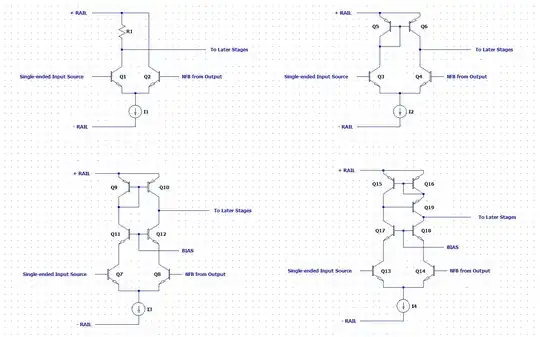
The first starts out just converting the diverted current into a voltage signal by inserting a resistor into the collector leg. (The other collector could also have a resistor in its collector leg, as I know you are already aware. But then you'd have to deal with a differential signal output, which you already are having trouble with, and I think it is more important that you avoid that 'difficulty' and instead just figure out and understand how to use a half of it as a single-ended output.) Most of the time, this upper left topology isn't used. But don't move away from studying this one until you are confident calculating its voltage gain given a current source value and a resistor value.
The second uses a current mirror as a load and vastly improves the resulting gain. Here, the resulting gain will require that you understand the idea of \$r_o\$ and the Early Effect. Again, don't move away from this until you can confidently gather up the voltage gain given the Early Effect present. (In the idealized case of no Early Effect it can be seen as transconductance.)
The third case uses a cascode stage. You will find this topology (or a closely related one) used in BJT opamps. This improves the gain of the input stage enough to sometimes be worth the extra trouble.
The fourth case converts the current mirror to a Wilson mirror, for a relatively large improvement in gain.
This is just the first stage.
I'd recommend then spending time studying various incarnations of the output stage. Not just class-AB but also class-A. And at some point get a clue about the value of a Zobel for the output (oscillation due to various forms of speaker loads and cabling.)
Once you've settled on the type of output stage (and feel confident about them) and the input stage, all you have left to worry about is the intermediate stage (often just called the VAS) that mediates between your chosen input and output stages. There's more to study there, of course. But with the input and output stages in hand, there's fewer forms to worry about for the middle and you can narrow your scope of ideas. And of course, you do need to understand NFB and hooking that up, properly, too.
It would also help a lot if you focus on a headphone amplifier, first. These require only milliwatt outputs and this means far less complexity. You don't have to worry much about the power supply itself (it's easy for low power like this) and you don't need to worry about thermal tracking or dissipation issues, though you still need to worry about ambient operating temperature variations. (Emitter degeneration helps with discrete parts, with a voltage gain cost, and/or you can buy matched BJT pairs.)
(Of course, designing current sources and vbe-multipliers are yet still other specialized areas to gather up. The learning doesn't ever really stop.)


