1

I'm developing a circuit project to bypass the current of several lamps in series in case one of them burns out.

enter image description here

Initially, my idea was to put a resistor in parallel with the bulb, so that when the bulb burned out, the current would pass through this resistor. The problem is that my current in the bulb can't change, i.e. I can't put a resistor equal to the resistance of the bulb, since then the current would be divided between bulb and resistor, I would have to put a resistor big enough so that most of the current would pass through the bulb while it was working. This means that when the bulb burns out, opening the circuit, all of the 6.6A current passes through the resistor and, because it has a high value, it generates a very high voltage.

My second idea would be to put a diode in parallel with the bulbs so that when the bulbs burn out, the current would have to pass through the diodes. When I tested it with direct current, I saw that it would work, but with alternating current, I saw that it wouldn't work very well.

I would like your help to find out what else I could try. The resistance of the bulbs is approximately 2.4 ohms and the drop voltage is 15.9 Vrms.

  • What are the part numbers for the lamps? How many of them are there? – Null Aug 24 '23 at 13:24
  • Airfield installation? Is each bulb impedance matched via a transformer? – winny Aug 24 '23 at 13:30
  • 1
    Bypassing open bulbs, unless maintained and replaced continuously, is asking for trouble. Have a seasonal ornament with hundreds of "short when fail" bulbs. A few can go out, but then a chain-reaction happens and all of them burn out. – rdtsc Aug 24 '23 at 14:07
  • it's for an airfield and there are 3 lamps – Rafael Gabriel Aug 24 '23 at 14:19
  • @rdtsc No chain reaction due to constant current. Airfields use this due to redundancy that any open or closed circuit on the secondary side will not cause others to fail. The penalty is isolation voltage as the first (or last) will be pushed up high in voltage above ground. – winny Aug 24 '23 at 14:31
  • 1
    @RafaelGabriel The voltage across each lamp is 6.6x2.4=15.84$V_{rms}$. If you only had 3 lamps, you would only need a 47.52$V_{rms}$ supply. With such a supply, you would not get 1000 V across a dead bulb. Therefore, I am assuming there is many more than 3 bulbs. – Math Keeps Me Busy Aug 24 '23 at 15:03
  • Is 2.4 ohms the cold or hot resistance of the filament? Hot resistance is about an order of magnitude higher than cold resistance. What is the bulb AC RMS dropout voltage with hot filament? Please edit the question and add those details. – Kuba hasn't forgotten Monica Aug 24 '23 at 16:00
  • Have you considered a bi-stable relay? You'd have to reset it manually after each lamp replacement but would have very low losses both in normal operation and bypassed. – winny Aug 25 '23 at 08:01
  • Thanks guys for the tips, doing some tests I managed to come up with a solution thanks to your tips – Rafael Gabriel Aug 25 '23 at 14:26

4 Answers4

1

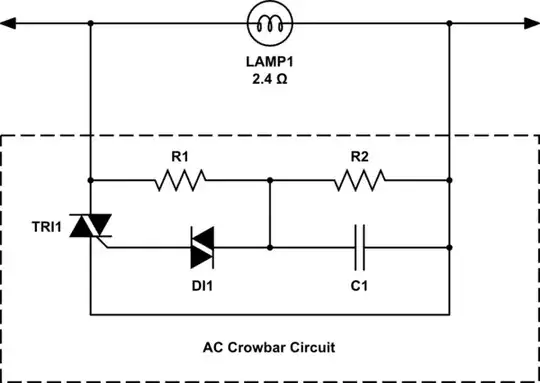
What may work for you is to put an AC crowbar circuit across each bulb. With the bulb operating correctly, the voltage across it will be 2.4 \$\Omega\$ x 6.6 A = 15.84 \$V_{rms}\$ = 22.4 \$V_{peak}\$. Since you have many bulbs in series, when one burns out, the voltage across it will begin to rise toward the supply voltage. If you set your AC crowbar to fire if the voltage rises above, say 30V, it will bypass that bulb. Since there are many bulbs in series, the voltage across the faulty bulb should reach 30V very quickly. The circuit might make the bulbs slightly dimmer (because they are not on for the full cycle) or slightly brighter (because one in the string is bypassed, when the bypass is on). That may or may not be a problem that needs to be addressed.

A simple AC crowbar circuit might look something like this:

schematic

simulate this circuit – Schematic created using CircuitLab

Math Keeps Me Busy
  • 23,260
  • 4
  • 21
  • 75
0

You say the lamps are 6.6 A and 2.4 \$\Omega\$, but also the voltage across the resistors would be 1000 V. These numbers don't jibe. 6.6 A at 2.4 \$\Omega\$ would be 15.84 V across each lamp, if the resistor is a similar value to the lamp that's what the voltage across it should be.

You would need the bypasses to present an impedance similar to a lamp, otherwise the voltage across the rest of the lamps, and their brightness, will change. You won't be able to do this with a simple resistor, with the lamps working the impedance of each will be the lamp's impedance in parallel with the resistor, when one burns out the impedance of that one will be just the resistor, so the other lamps will be dimmer.

One possible solution is to use a photo-sensor on each one that will sense when the lamp is not working and use a relay to switch a load that will mimic the lamp's impedance into the circuit.

GodJihyo
  • 22,826
  • 1
  • 20
  • 58
0

I'm developing a circuit project to bypass the current of several lamps in series in case one of them burns out.

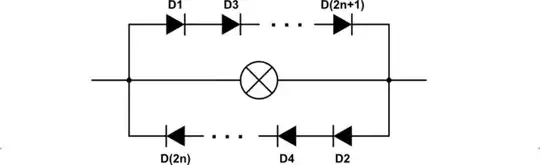
Airfield lighting systems with passive lamps use series-connected transformers to drive the lamps. These transformers are not cheap, but the primary circuit remains closed at all times.

I imagine you're trying to have a system without the transformers to lower costs.

Measure the voltage across the lamps when they are ON. Convert that to a number of diode drops. Then add that many diode drops across the lamp, plus a some extra to accommodate temperature differences and lamp differences. The lamp assemblies have to operate from -50C to 100C inside the case at least, last time I looked at it - or a similarly wide temperature range. You'll need to do environmental chamber tests, and really measure the performance of those diodes.

schematic

simulate this circuit – Schematic created using CircuitLab

The diodes will, in aggregate, dissipate as much power as the bulb when they take over the bulb's operation.

Initially, my idea was to put a resistor in parallel with each bulb.

That resistor would have to dissipate about as much power as each bulb. That's a no-go.

0

A 1:1 isolation transformer, per lamp, should suffice.

enter image description here

The continuity of the series lighting loop is maintained even if one or more lamps fail.

vu2nan
  • 18,175
  • 1
  • 16
  • 47