3

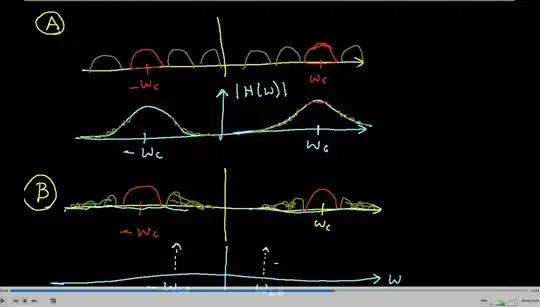
Why is that in the frequency domain, I always see mirror images? What causes these mirror frequencies to appear? How do they pop in? Where do they come from?

Secondly, what is this concept of negative frequency? In normal life, most of the time I only hear people mention the positive frequency. What is the role of the negative frequency and why is it always a mirror image of the positive frequency.

The lowest figure shows the frequency domain of a cosine function (two impulses appearing, also a mirror image)
enter image description here

vvavepacket
  • 2,503
  • 9
  • 41
  • 57

1 Answers1

3

Both the signal and the Fourier transform can be complex functions, but some interesting and useful simplifications are possible when either of these functions are purely real or purely imaginary.

when the time signal is purely real the fourier transform is said to be obey Hermitian symmetry.

\$X(-f)=X^*(f)\$

\$|X(-f)| = |X(f)|\$

\$argX(-f)= -argX(f)\$

if the time signal is purely imaginary then the fourier transform is said to be skew hermitian.

\$X(-f)=-X^*(f)\$

which will manifest itself as not a reflection but an inverted reflection.

So in short commonly used transforms and modulations will have the properties that you mention.

placeholder
  • 30,170
  • 10
  • 63
  • 110