This may be a weird question, but I simply can't figure out, why you can entirely ignore current sources when calculating the input resistance of circuits.
Here is an example (it's actually a small-signal model of a BJT-circuit):
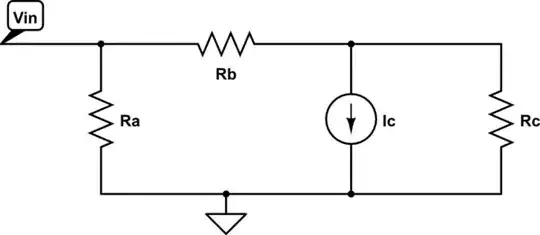
simulate this circuit – Schematic created using CircuitLab
When you want to find \$R_{in} = \frac{V_{in}}{I_{in}}\$ you end up with \$R_{in}= R_a\,||\,(R_b + R_c)\$ (at least that's what the sample solution sais).
However, intuitively I was thinking: When there is a lot of collector current flowing around, with \$R = U \cdot I\$ the resistance will go up. And only when there is almost no collector current left \$(I_C \to 0)\$, I was expecting:
\$R_{in} = \dfrac{V_{in}}{I_{in}} = \dfrac{(R_a\,||\,(R_b + R_c)) \cdot I_{in}}{I_{in}} = R_a\,||\,(R_b + R_c)\$.
But obviously that is always the case. Can anyone explain to me, what I'm missing here?