-3

I want to build real circuit, which converts AC signal to DC.

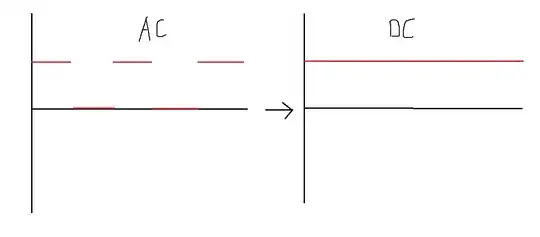
AC signal looks like below: enter image description here

Its period T is about 2 seconds.

At the output I want to get DC as shown in the right graph with voltage 12V and current is 2.1A to get power 25W.

Can someone provide circuit to convert this kind of AC to DC with the exact characteristics of each element, I mean resistance,capacity,etc? Note that the amplitude of input AC is about 11.5V.

Anindo Ghosh
  • 50,446
  • 8
  • 105
  • 201
Nurlan
  • 103
  • 1
  • 4
  • 1
    I noticed that your last question and an answer (http://electronics.stackexchange.com/questions/77754/increasing-voltage-using-operational-amplifier) didn't get feedback from you so maybe while you are on-line you can amend that question if the answer didn't help. Is this question related? It seems similar - that's what triggered this comment. – Andy aka Aug 04 '13 at 20:08
  • @us2012 Right, I know it was a bit of an over-simplification. But I was assuming there was some load, and did say "all other things constant", the current being one of those. Anyway, it was a bit too inaccurate and will remove it. – Jonathon Reinhart Aug 04 '13 at 20:44
  • 1
    It is not reasonable to simply say that you want a DC output. It is impossible, for practical purposes, to have an output voltage that does not vary at all. You must provide a specification for the range of acceptable output voltages, something like 12V+/-1V or 12V+/-5%. Be aware that a smaller tolerance for voltage variation increases the cost of the solution. – Joe Hass Aug 04 '13 at 20:48
  • 2
    That input seems really strange... what you've drawn is a switched DC input (time-variant, but unipolar), not "AC" (bipolar) in its most common usage. Are you sure it doesn't swing both above and below your reference level? What's generating it? – DrFriedParts Aug 04 '13 at 22:56
  • Just out of curiosity: What is the source of the pulsing signal, and what current can that signal sustain? – Anindo Ghosh Aug 05 '13 at 00:09
  • Andy aka, I solved problem by using relay. What else do you want? – Nurlan Aug 05 '13 at 02:50
  • DrFriedParts, I measured input signal with voltmeter. The signal is generated by car alarm – Nurlan Aug 05 '13 at 02:56
  • @NurlanKenzhebekov So the car alarm signal provides a 2+ Ampere output? What kind of alarm is supposed to be attached to that line? – Anindo Ghosh Aug 05 '13 at 04:00
  • Siren requires 12V and 25W current. That is why I need such current – Nurlan Aug 05 '13 at 08:28

2 Answers2

3

You are talking about supplying 25W for 1 seconds, that requires storing a LOT of energy. I don't think capacitors or inductors will help you here, you will have to look for chemical storage (high-current batteries), or more exotic things like flywheels.

Another problem is the voltages: your 'AC' seems to supply alternating 0V and 11.5V, so you will have to include some way (switching mode voltage converter?) to raise the voltage.

All in all this is a far from trivial project!

Wouter van Ooijen
  • 48,572
  • 1
  • 63
  • 136
1

You want higher voltage out than in at significant power. This will require some sort of switching power supply in practise. You also need significant energy storage to ride out the times when there is no input power.

The correct approach is likely to step back two levels and think about the problem differently. This looks like you are asking about a detail of some imagined solution where what is really needed is a better approach.

However, to answer the question directly, I'd probably make a switching power supply that charged a 12 V car battery when input power is available. The output is the car battery output directly. As long as sufficient current can be drawn from the intermittent input voltage, this system should be sustainable long term (the battery will not be discharged on average).

Note that the switcher will have some inefficiency, so more input current is needed during the input bursts than you might otherwise think. The output needs to deliver 12 V x 2.1 A = 25.2 W. Since the input is on half the time on average, a total of 50.4 W is needed when it is on due to power conservation alone. Let's say the switching power supply is overall 80% efficient. That means the input must supply 50.4 W / 80% = 63 W when on. The current that the switcher will draw from the input during the on phase will therefore be 63 W / 11.5 V = 5.5 A.
Olin Lathrop
  • 313,258
  • 36
  • 434
  • 925