8

Sometimes underground pipelines are exposed due to vertical scour or lateral migration of streams (or other erosion). One option is to lower the (in-service) pipeline to a new depth that provides sufficient ground cover.

How can I determine the mechanical stresses on the pipe, and determine how much the line can be lowered? Also required is determining what length of trench will be required to accommodate the lowering. What are the relevant codes or standards?

This question is in relation to steel pipelines for both gas and liquids.
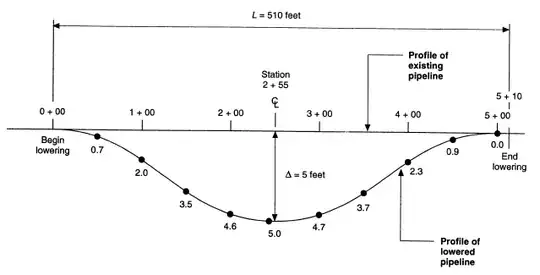
Pipeline Lowering Profile

JustInTheWoods
  • 181
  • 1
  • 3
  • This is a neat question. How do they go about lowering a pipe? Do they just remove the supporting soil underneath and let it bend itself...? – Rick Jan 21 '15 at 15:49
  • Do the dots in the diagram represent connections of pipe segments? – Trevor Archibald Jan 21 '15 at 16:28
  • Yes, Rick. Gravity does the bending. The pipeline is temporarily supported while soil is removed. The pipeline is then gradually lowered onto the new trench bottom. – JustInTheWoods Jan 21 '15 at 18:02
  • The dots are just representative points along the profile to show depth values. The pipeline is connected by welding and does not need to be represented in this analysis. – JustInTheWoods Jan 21 '15 at 18:04

1 Answers1

6

This is something that I've looked at with tunnels, rather than pipes, and arguably with smaller deflections. Hopefully it'll be some help, however.

If you can satisfy yourself that the rate of curvature is relatively small- then you can approximate the stress generated by the lowering using simple beam theory:

$$\sigma=\frac{Ey}{R}$$

Where:

  • E is the Youngs Modulus
  • y is the distance from the neutral axis you are measure the stress at (i.e. the radius of the pipe itself)
  • R is the radius of curvature.

Mechanically, you'll need to check that the stresses in the pipe along the parabaola that defines your curve never exceed the limiting stress of the pipe material, and (probably more critcally) the capacity of the connections.

This is a bit of a simplification, and depending on the type of pipe, the joints themselves will have some play.

thomasmichaelwallace
  • 934
  • 2
  • 10
  • 27