4

Why don't cellphones use unidirectional antennas instead of omnidirectional (single dipole) antennas?

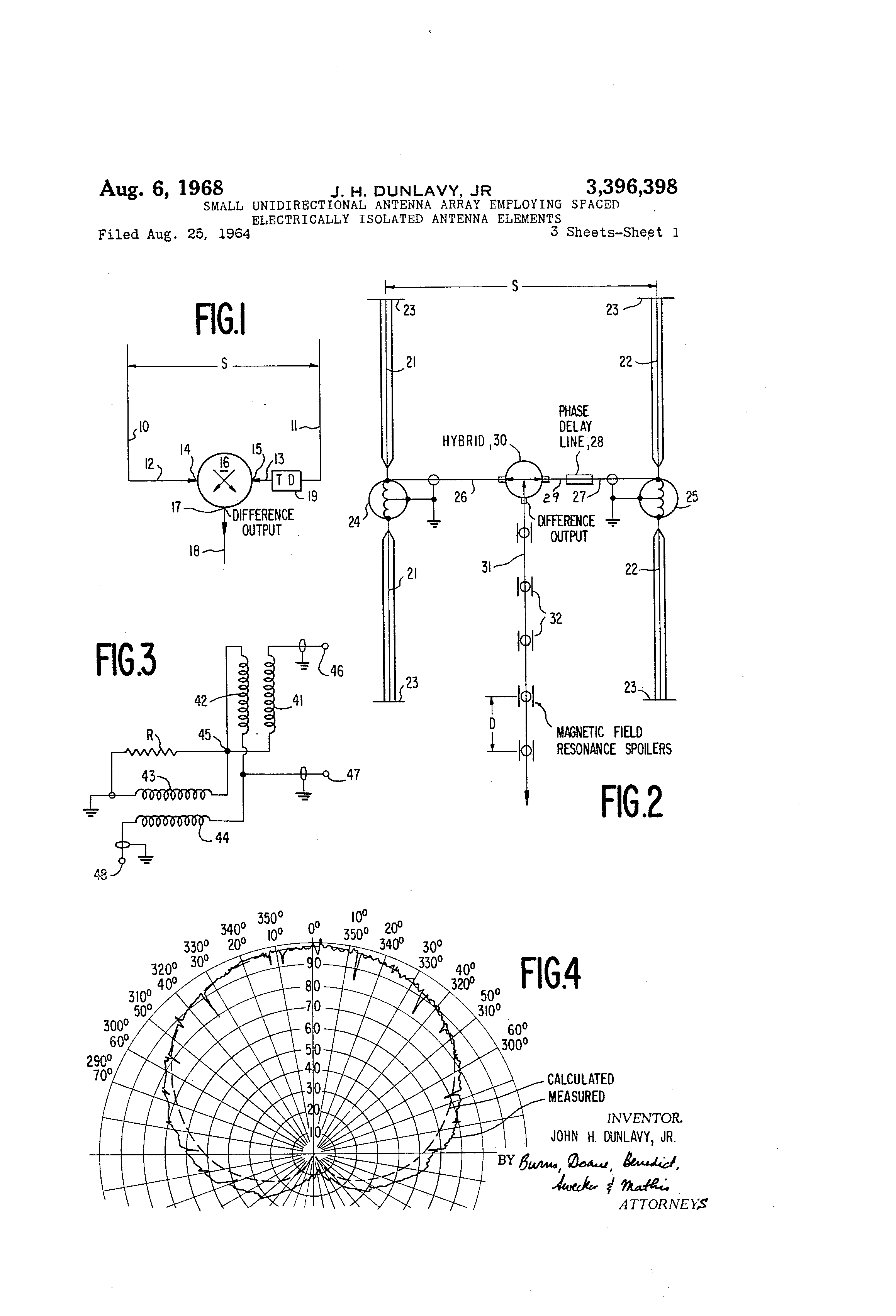
This could be accomplished by using a unidirectional array of dipole antennas (specifically, a broadside array) placed at different locations in the phone, where each antenna's phase could be changed in such a way to minimize radiation directed into the user's head and maximize radiation sent in the direction of the cell tower, producing a radiation pattern as is shown in the picture below.

But, with digital electronics, arbitrary phase-delays could be introduced to change the orientation of the major lobe.

Cellphone batteries would last longer and there would be less adverse health effects due to EMF exposure. Unidirectional Array
Geremia
  • 393
  • 3
  • 10

2 Answers2

1

The answer when this question was asked was mostly size and cost of components and technical limitations around the size of the antennas and the limited space inside a phone.

Since then, the answer has changed, and modern phones do in fact use phased arrays.

Both WiFi 6 and 5G cellular chipsets support this, at least in some devices, and it's been supported on the access point side going back a generation or two.

And they do it for pretty much the reasons you laid out, since while consumers may not think overly much about the radiation from their phones, they do consider the battery life. And minimizing energy used to transfer data does improve battery life and reduce overheating.

The tradeoff is that there are some angles where your phone really will get a much worse signal depending on a few other factors like the number of available access points and the signal strength / signal to noise ratio.

Kyle
  • 11
  • 1
1

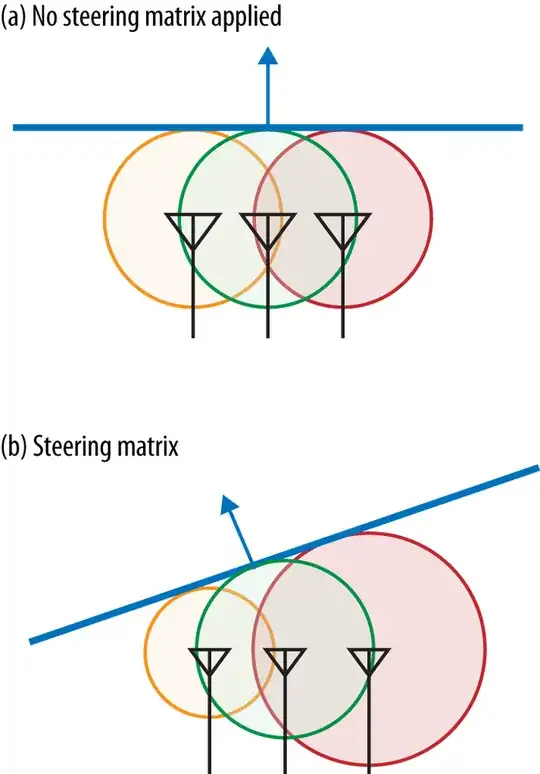
This is called beamforming, which exists in the 802.11 wireless standard.

Matthew S. Gast, 802.11ac: A Survival Guide, glossary:

Beamforming
A method of using precise phase shifts on an antenna array that focuses the resulting transmission in a particular direction. Sending beamformed transmissions may require an exchange of control information to set up the antenna array.

Beamformee
The receiver of a beamformed transmission. The beamformee may need to transmit some packets in a beamforming setup exchange, but the main purpose of the beamforming exchange is to receive a directional transmission.

Beamformer
The sender of a beamformed transmission. The beamformer may need to receive some packets in a beamforming setup exchange, but the main purpose of such an exchange is to send a directional transmission.

ibid. Chapter 4. Beamforming in 802.11ac, ยง Beamforming Basics:

Figure 4-4. Using multiple antennas to steer transmissions

There is Single-User (SU) Beamforming and even Multi-User (MU) Beamforming.

Geremia
  • 393
  • 3
  • 10