2

When we do detailing for RC structures, the rebars in a beam have to anchor into a column. For an external column (not at the roof), the rebars are usually bent in 90 deg to provide sufficient anchorage length.

When I read the design manuals, books, etc, the rebars are always bent to the far face of the beam. E.g. The top bars in the beam bend to the bottom and the bottom bars bend to the top.

May I know why is the bending direction always like that?

Cyrus.H
  • 21
  • 1
  • 3
  • bending beam top rebars up and bottom bars down would certainly avoid congestion rather than otherwise in that part :) – eleazer Aug 13 '24 at 04:50

3 Answers3

2

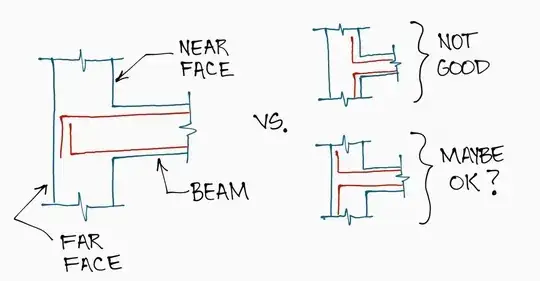
It sounds like you're inquiring about the development of rebar at RC beam-column connections. Based on my (largely academic) experience, you're likely looking at something similar to this:
Rebar Detailing

A key attribute is extending the beam bars to the far face of the column. Realistically, all connections are somewhere between fixed and pinned, but extending the bars straight to the far column face rather than the near face more closely approximates a fixed condition. This detailing approach also gives the joint the best ductility - critical in seismic applications.

Why bend the bars at all? Because the full tension strength of the beam bar needs to be developed at the near face of the column and this requires a certain length of rebar to be embedded in the concrete. In general, the only way to accomplish this is to hook the bars.

Why bend the beam bars so that they enclose the beam rather than having them stick up and down along the column length? I assume it's to do with avoiding rebar congestion but I don't know for sure. So long as the hooked development length is achieved, it seems like a qualitative preference to me.

CableStay
  • 2,770
  • 1
  • 16
  • 29
0

The reason is simple geometry.

The top bars have the most clear space to bend down. They can't bend up (out of the beam) and bending to one side or the other means that they are likely to interfere with other bars.

This doesn't mean that the bar have to bend that way. If there is enough room to maintain clear spacing, the bars could bend any way.

hazzey
  • 10,730
  • 11
  • 46
  • 96
0

The reason for bending the top bars down and the bottom ones up are to create a box which would act as a added ductile component to hold as a cage the end part of the beam even in cracked condition.

In a major earthquake or in case of a catastrophic failure concrete can break into small chunks losing the stiffness. Bending of rebars in a this way will hold the cracked joint together stopping the building from collapse, providing precious time for evacuation.

kamran
  • 23,517
  • 2
  • 22
  • 42