I'm intrigued by this video in which the roof camera rotates continuously. One reason could be to capture 360 degrees around, but then again two cameras or more could do the same job capturing different parts of the landscape. It seems to me a waste of energy in making the camera rotate, and also having mobile parts make it more vulnerable to breaking. I don't see why not using a system of many static cameras.
Asked
Active
Viewed 284 times

2 Answers
7
It isn't an ordinary video camera. It's a high-resolution LIDAR that uses laser beams to measure the distance to thousands of points on every rotation. I believe the one used by the car in that video is the Velodyne HDL-64e, which I have used myself on a similar project.
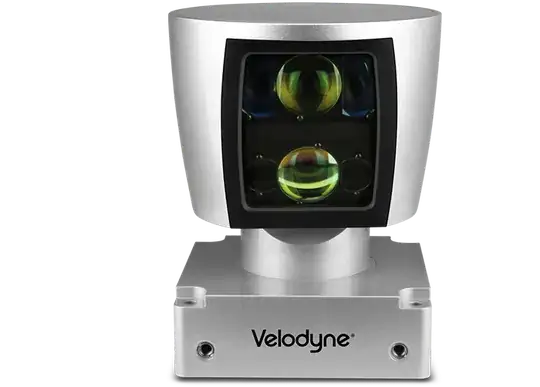
It sends out a vertical array of 64 pulsed laser beams and uses time-of-flight to measure the distance to a reflective object. The physical rotation gives you the scanning in the horizontal direction. The data is in the form of a "cloud" of 3-D points that represent reflective surfaces that the sensor can see. It's fascinating to watch a 3-D plot of the raw point cloud change in real time as both the sensor and the objects in view move.
It takes quite a bit of sophisticated software to connect the individual points together to represent actual surfaces and objects. It is the output of this software that you see in the video, representing vehicles, pedestrians, etc. as boxes that approximate their actual shape.
The resolution of the sensor is specified as angles (0.4° vertical, 0.08° horizontal), so the actual spatial resolution depends on the range. For example, at a range of 10 m, the vertical resolution is about 6 cm and the horizontal resolution is about 1.3 cm. The range resolution is about 2 cm.
This particular sensor is the "gold standard" for such devices, used in research projects where the accuracy of the data is paramount and cost is no object. It's far too expensive to be used in a mass-produced vehicle design. Indeed, it may require a breakthrough in 3-D (stereoscopic) image processing algorithms using cheap video sensors to get to the point where the data required for navigation can be acquired at a reasonable cost.

Glorfindel
- 279
- 1
- 5
- 11

Dave Tweed
- 7,273
- 1
- 22
- 41
4
That's a lidar sensor, which is making a continuous 360 degree sweep, rather than a camera which has a field of view as such. Rotating mirrors are a fundamental part of how the system works.
Note that in the video the system represents traffic as fairly crude boxes rather than rendered images, so it may be looking specifically at reflectors, which also helps it to identify signs and traffic cones.
Also, they are talking very much about the software and control systems, so it seems likely that the sensor rig in the video is chosen to be convenient for testing, rather than a fully developed and refined consumer version.
In practice, a fully autonomous car may well need a variety of different sensors to guarantee redundancy and effectiveness on a variety of conditions, but in good weather with a professional human driver supervising the vehicle, a bolt-on lidar sensor is a convenient way to fine tune the software.
Glorfindel
- 279
- 1
- 5
- 11

Chris Johns
- 15,326
- 3
- 24
- 42