Wing loading:
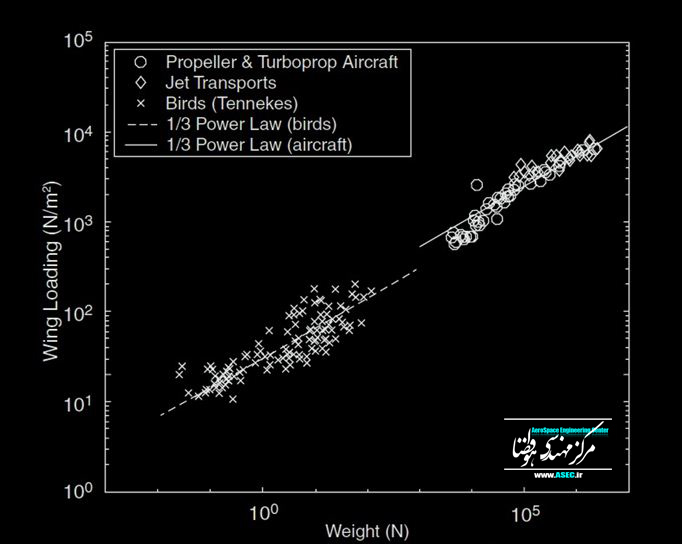
The graph below provides areas for living and man made flying machines - and this can be seen to be a quite good log-log fit of mass and wing loading. See his text for comment on the departure of Humming birds from the continuum mapped by most other birds.
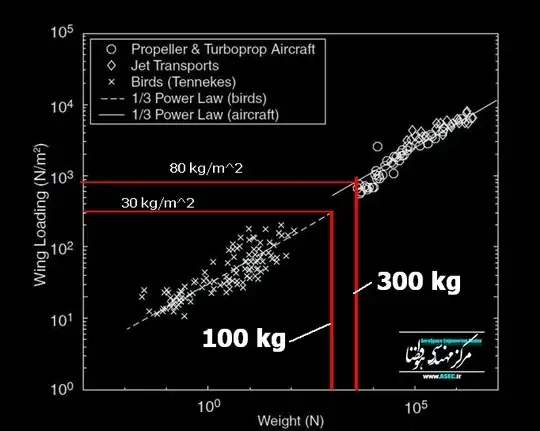
The graph suggests wing loadings of 30 to 80 kg/m2 as mass rises from 100 to 300 kg.
Or about 3.3 m2 at 100 kg and 3.75 m2 at 300 kg.
ie close to constant across your likely mass range.
If correct, this answers your question regarding area.
The graph of wing loadings below is from the site referenced below.
I have added the red lines and white text.
Not that he works in Newton and I have roughly converted to kg.
Flapping rate - "flat plate lift":
Based on the drag equation, and miscellaneous assumptions (which I can explain if of enough interest) I estimate a required "flapping rate" of about.
Flaps per second ~~~~~>= 4 x sqrt(Mass kg / Area m2) / stroke2
= Fps = 4.sqrt(M/A)/stroke2.
Stroke in meters## Heading ##.
e.g. for 4 m2 wing area, 160 kg load, 1.0 metre stroke:
Flap rate >= 4 x sqrt(160/4)/1.0 = 25 flaps/second
This is based on the force on a flat plate when waved in air at sea level in one direction over a linear distance = 'stroke' art a rate of 'flap rate' per second with drag in one direction and mone in other, and high drive:return time ratio.
(Using drag equation - Force ~~~= 0.6 x Rho x Cd x A x V2. )
_______________________________________
Ornithopter wing design algorithm:
MATLAB code for the wing design is given here on this page.
Due to 'potential navigation difficulties' due to language used I have appended the simple sample code at the end of this answer.
____________________________________
The structure of bird wings with applications to ornithopters
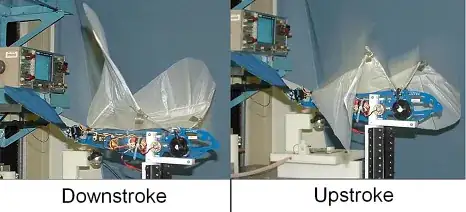
The first animated GIF is of arguable usefulness but a great thought starter -
Wheeee!
See also Aerodynamic ornithopter fixed wing considerations - all sorts of technical goodies.
Real world non-ornithopter but relevant man powered flying machine
The man powered flying machine in the videos below is not an ornithopter but maintains takeoff & flight lift based solely on "man powered" surfaces and the same basics can be applied. In the video example there are 8 unidirectionally driven lifting surfaces. An ornithopter could conceptually drive the same area at about the same mean forwards velocity but with powered downbeat and (probably) liftless upbeat to produce the same net effect.
For now, see this most lovely 1m30s video
Also (slightly longer) https://www.youtube.com/watch?v=syJq10EQkog
and slightly longer 'making of'
Some hard data and real models here.
In Iranian (Persia)(Farsi?)- web translate works OK.
Aerodynamic design wing ornithopter
http://s6.picofile.com/file/8266611400/52.JPG
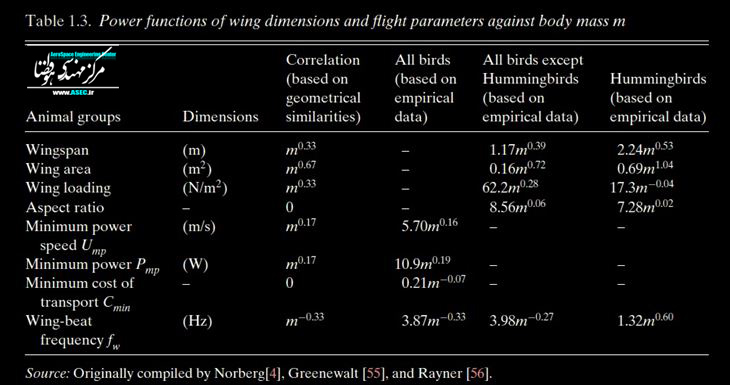
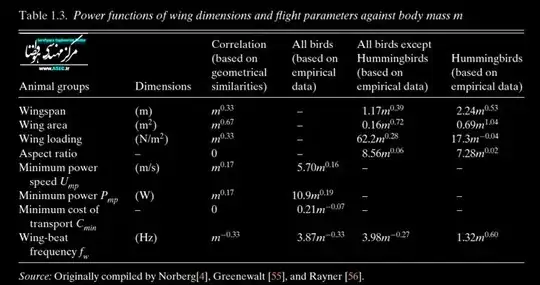
His table of wing functions vs wingspan is liable to be of interest.
This gives values for all birds for (as well as other hings) power, wingspan, wing area, power in terms of body mass
Span = 1.17 x m0.39
Power = 10.9 x m0.19
Beat rate = 3.98 x m-0.33
Plugging ornithopter scale data into these suggests I'm missing something. TBD.
http://s6.picofile.com/file/8266611518/55.JPG
MATLAB Ornithopter wing design code **from **
Pasted as is - see source page.
EXCEPT in the following code I have used ~ as the multiplication operator. Markdown renders pairs opf asterisks as italics bounds. Replacing with a ~ allows simple find and replace (rather than adding markdown to the code)(or using a 'code' block.
%% ---------------Ornithopter Wing design -------------------- %
--------------------- wwww.Asec.ir -------------------------
clc;clear;close all
%% Fase ONE.....
m=0.4;
AR=3;
W=m~10;
W_S=30.6~W^(1/3)
S=W/W_S
span=sqrt(AR~S)
a=span/2;
b=S/pi/a
f=3.98~m^(-0.27)
x=0:a/20:a;
y=b~sqrt(1-(x./a).^2);
Xc=[0 a];Yc=[0 0];
X=[0 x];Y=[0 y];
fill(X,Y,'b','LineWidth',3);holdon;plot(Xc,Yc,'r','LineWidth',3);axis equal
text(a/2,3~a/4,' \leftarrow MAC','FontSize',14)
%% ---------------Ornithopter Wing design --------------------
% --------------------- wwww.Asec.ir -------------------------