6

I'm interested in whether a flat rubber washer or equivalent is good enough to replace an o-ring in a low pressure application (edit: I meant low pressure differential. My bad.). The reason is that flat washers might be easier to design for if you have a dynamic seal application where one tube has to "air lock" against another tube.

The application is to mount an air sampling tube in such a way as I can automatically sample air and then, later, automatically heat the tube to 200C and pull the vapours.

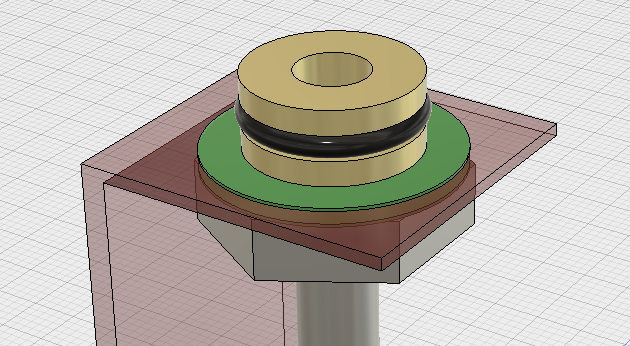
The tube is just a thin walled (0.25mm) steel tube 6mm or so in diameter and 40mm or so long). Here's how I initially imagined the system:
enter image description here

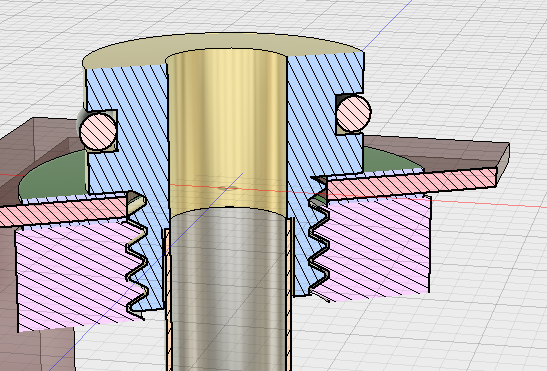
So some sort of automatic airlock connector tube could move out, seal against the o-ring and then stop at the green washer. The green washers might be something like mica or teflon, something able to take the 200C while insulating the holder - I want to heat just the tube, not everything connected to it! Here's a cross section:
enter image description here

I have some issues with this - firstly I'm not convinced that a metal to metal seal (tube against holder) will air seal properly, even when pushed by the automatic connector. Perhaps another o-ring is necessary?

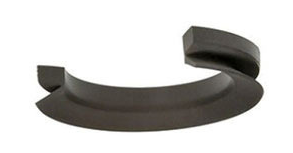
Secondly, mica washers aren't flexible (I think) and getting a washer into a groove like I've shown might not be possible. If I replace the washer with some form of flat seal which captures itself against a lip, perhaps this type of form:
enter image description here

As I would have to make the connector by machining or other process, perhaps this would make the design easier. But is such a v type seal effective at air sealing? The difference is that in the O-Ring, positioning is all that is necessary but with a flat washer type, you need force too (related link: What are the common failure points of waterproof cases?)

EDIT: Clarifications:

  • I believe I tried to present too much information at once and missed the important points!
  • The pressure differential should not be very high. I'm considering a flow, from outer atmosphere, of a few litres per minute through a sorbent. If the pressure diff was more than 1/2 atm I'd be surprised.
  • The green washers are really to provide heat isolation, not air sealing. If the sorbent tube is 200C I didn't want the entire system to try and be 200C too!
carveone
  • 347
  • 4
  • 9

3 Answers3

2

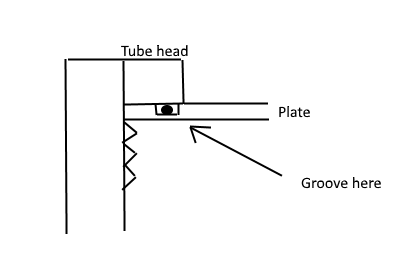
This really depends on what sort of vacuum / ultimate pressure you're looking for. For something in the millitorr range, this probably won't work. Maybe if you have a big pump and a small internal volume, you could get down to 50-100 torr. Your metal-metal seal here should be fine, assuming your O-ring groove is sized correctly (and for the right pressure direction). You may want to make your O-ring groove on the deep end of the tolerance range for proper sealing so it does not get pinched when your outer tube moves into place. The face seal between the outer tube and your washer will be a problem, I think.

Something like PTFE isn't usually flexible to get a correct seal in most vacuum seal applications. Mica definitely won't be. I would opt here to put a second O-ring where your washer is; I'm not sure the washer, even if it was rubber, would necessarily have the right flex and shape to seal the gap. There are high temp vacuum O-rings like Kalrez (and others that are not as pricey) that should handle 200C without a problem.

The easiest thing might be to simply embed the O-ring in the plate where you would have your washer located. I tend to opt for the conservative method of a proper O-ring because with a minimum amount of design, they do a great job of a very predictable and consistent seal. It will be much harder to guarantee that with a washer, and it's always annoying and costly to send something back to the machine shop.

Alternatively you can move the O-ring out further on the plate so it gets sealed against when your outer tube moves into place (probably the best choice, now that I think about it...), or embed the O-ring in a groove on the tip of the outer metal tube. Unloading the tubes with an O-ring in the plate seems like it wouldn't be too bad.

Terrible drawing:

enter image description here

phyllis diller
  • 407
  • 2
  • 12
2

A properly designed O-ring seal will be your best option, though for 200C operatiing temperature, you'll need O-rings made from a material than is designed to function at that temp, like Silicone or Fluorocarbon (FKM) rubbers. O-rings are popular because they work well in so many applications and they're cheaper overall than anything that functions as well.

With any O-ring seal, static or dynamic, the key parameter is "O-ring Squeeze" which is defined as the percentage reduction in cross sectional area when compressed from the free state. Since the o-ring acts like a spring, this squeeze is directly related to the sealing force. The greater the squeeze, the greater the sealing force, and the greater resistance to leakage...at least in general.

As with most things, more is not always better, too much squeeze can result in a poor joint since it can cause excess stress in the mating parts, excess friction (in the case of a dynamic seal), and O ring damage since there's a greater risk of the o-ring getting pinched between the two mating surfaces.

In designing O-ring seals in stainless steel with good surface finish, I would try to stick to < 15% squeeze for dynamic seals and 15%-30% for static seals using a standard NBR O-ring from Parker, but it really depends on the type of O-Ring, the materials involved and all of the other specifics of the application. In this case, you'll want to look at the properties of whatever material you choose and as with any quasi-dynamic joint like the one you describe, smooth mating surfaces and lubrication are essential. (I recommend Krytox grease, pricy, but a little goes a loooooong way. You just need enough grease to make the O-ring look wet.)

There's a lot that goes into the design of a good O-ring joint. The best resource I've found is the Parker O-ring Handbook

Source: I designed and tested engineered mechanical seals for 5yr

DLS3141
  • 2,155
  • 11
  • 16
1

My push on connector with flat washer rubber is good for 2 bar diff press. Actually, o-ring seal inside socket connection maybe easier for assembly & disassembly. Difficult fabricate, yes.

RainerJ
  • 21
  • 2
  • 14