4

I’m pretty sure it’s something to do with the fitting, possibly specifying to use the minimum circumscribed or maximum inscribed circle to tolerance the diameter but I can’t remember.

The tolerance would be in the form

⌀123 ± 0.01 Ⓔ

In case the Unicode doesn’t work correctly that’s

[Diameter Symbol] [value] [plus minus symbol] [value] [E in a circle]

Notts90
  • 143
  • 1
  • 1
  • 4

2 Answers2

3

Like promised, I am now looking at EN ISO 14405-1:2016 where this E symbol (Ⓔ) is defined. More accurately is defined in section "3.8 envelope requirement".

  1. The upper value of a external feature defines a virtual cylinder that the entire feature has to fit inside. Likewise a internal features minimum value defines a cylinder that has to fit inside the hole.

  2. Each slice of needs to be smaller or bigger (for internal features) than the other tolerance value measure as a two point size (imagine measuring with a caliper)

Note: Nowehere does it say the cylinder is aligned to the centerline
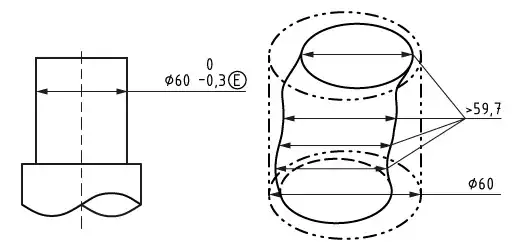
enter image description here

Image 1: Cylinder needs to be inside the envelope and not point measured smaller than the minimum size.

See relevant standard for more robust explanation.

joojaa
  • 3,691
  • 1
  • 17
  • 31
2

The Ⓔ is one of the options in the "feature control frame" as defined in the ISO 8015 standard, or ASME Y14.5M.

It stands for "envelope requirement." The basic idea is that the tolerance of the feature should not exceed the perfect geometrical shape at the maximum material size, which is identified by the symbol Ⓜ.

See http://www.globalspec.com/reference/43764/203279/chapter-10-envelope-requirement for an example. The standard documents themselves give the definitive explanation, of course.

alephzero
  • 12,578
  • 1
  • 16
  • 28