For example, take a look at the following static systems.
Assume they have the same length and the same (constant) cross-section. Thus an equal allowed bending moment $M_u$.
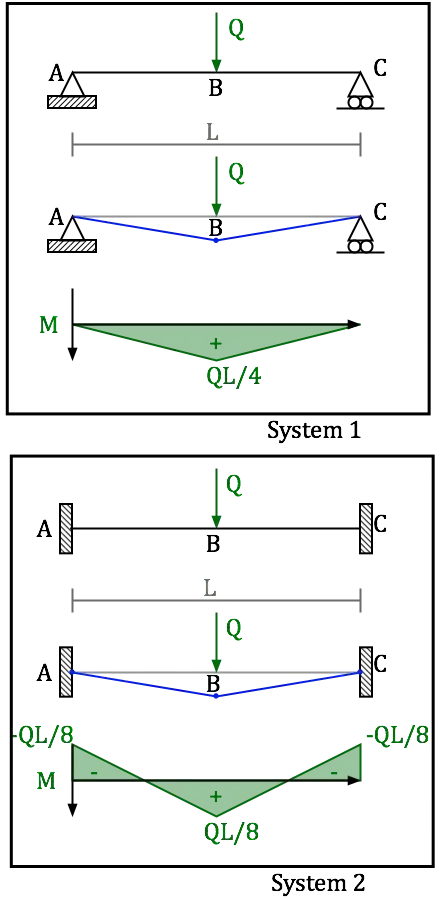
The first system is statically determinate, as it is supported only by simple supports. The maximum moment developing within the beam is $M=\frac{QL}{4}$, thus the load under which the beam fails is $$Q_u=4\frac{M_u}{L}$$
This coincides with the formation of a plastic hinge at point B, which leaves the systems statically under-determinate, a mechanism.
In the second system, the beam is supported by two clamped supports, which both reduce the maximum moment at the point where the load is applied. If you determine the static forces within the beam you will find that, neglecting residual stresses, the maximum moment $M=\frac{QL}{8}$. Thus,
$$ Q_u=8\frac{M_u}{L} $$
To turn into a mechanism, three plastic hinges have to be formed, which requires more work.
Hence the second system theoretically can bear twice the load of the first system.
Statically indeterminate systems in general are more stable and more rigid, but harder to calculate. Another important factor are the above-mentioned residual stresses, resulting amongst others from thermal expansion or the manufacturing process (e.g. inhomogeneous cooling of steel).

