25

In a gas turbine engine there're multiple sets of blades - one set after another and combustion products pass all the sets and each set of blades gets some of the power. This increases utilization of power from burning gas.

Meanwhile hydroelectric plants use turbines with a single set of blades and the typical usecase is where there's a channel for feeding water from an elevated reservoir and the turbine is at the bottom and water runs through the turbine and then just flows down the river. I assume there's still some mechanical power left unextracted when water flows out of the turbine.

Why are water turbines not "chained" so that water exiting the first turbine drives the second turbine using the residual mechanical power?

sharptooth
  • 2,129
  • 19
  • 28

5 Answers5

33

The exhaust gasses are compressible fluids, whereas liquid water is not.

Here's an animation of how a gas turbine works: https://www.youtube.com/watch?v=gqNtoy2x5bU

At the combustion stage, the gas and compressed air are mixed together, already at high pressure. The burning releases the energy stored in the gas, heating up the released gasses (exhaust). This would create an even higher pressure, so in order to prevent back-flow the combustion section is a larger volume to keep the pressure the same or lower. This large volume of high pressure gasses drives the turbine. As these high pressure compressed gasses pass through the first set of blades, the pressure reduces and the gases expand. There is still some pressure left and more energy can be extracted with another set of blades, and another, etc.

Since liquid water is not compressible, it doesn't expand as the pressure reduces. This actually makes it much easier to extract the energy. You pass the water through a nozzle, reducing the high pressure inside the pipe to atmospheric pressure outside the nozzle, and accelerating the water up to a high velocity. This energy can then be extracted all in one go by the turbine, because the water is not expanding and energy escaping elsewhere. Turgo turbines are actually very efficient at extracting this energy, up to 90%.

This is why multiple stages are not needed in hydro plants. However you could still 'chain' them together in the literal sense. If you have a very large drop, you could put a series of small turbines at intervals down the drop, the released water from one going into another. However, the amount of energy available would not change from having a larger turbine at the very bottom and using higher-pressures.

jhabbott
  • 5,990
  • 8
  • 32
  • 63
6

What's missing so far is an explanation why you can't expand from high pressure to atmospheric in a single stage gas turbine. There are two types of gas turbines - impulse and reaction turbines. Both face the same problem but it's easier to understand in the impulse turbine.

An impulse turbine accelerates the gas through a nozzle from high pressure P1 to a lower pressure P2, increasing its speed to V. The fast moving gas hits the turbine blades and gives up its momentum and kinetic energy, becoming slow moving gas at pressure P2.

The problem is that for some value of pressure difference, the speed V reaches the speed of sound (in that gas at that temperature). At which point the turbine blades are highly inefficient.

From a very old book I can't find just now about steam turbines (same thing : steam is a gas!) efficiency started to fall off somewhere around Mach 0.5 which corresponded to a 40% pressure reduction in a stage. (The actual velocity can be found from Bernoulli equation)

Which gives a way to find the number of stages you need to efficiently convert any given pressure ratio into shaft power. Given newer blade designs, Mach 0.5 may no longer be the upper limit but the same basic principle applies.

In an aircraft jet engine, after several stages of subsonic acceleration, the hot gases escape through one last nozzle and may well exceed Mach 1 to provide thrust for the aircraft - but not very efficiently. (The SR71 Blackbird's engines transitioned to a different mode of operation - practically a ramjet - for Mach 3 operation)

user_1818839
  • 1,640
  • 10
  • 11
4

The reason why a hydroelectric generator is fundamentally different to a gas turbine is because water under pressure is not a gas, and does not change size significantly as energy is extracted from it.

A gas engine has to account for considerable thermal and volume changes of the gases inside the engine, so multiple parts and multiple materials are generally required.

Hydroelectric turbines have different challenges, and have to tolerate items such as leaves and branches passing through them.

The design schemes of the rotating elements of hydroelectric turbines are substantially different to gas engines: archimedes screws, kaplan fans, Pelton wheels, crossflow turbines and water wheels.

Multi-stage designs are employed under some circumstances.

Da bishop
  • 41
  • 1
3

Water is going to have to leave the turbine at a speed. That what you've referred to as its residual mechanical power. The thing is, the turbine has already slowed down the water as much as can reasonably be done, while still allowing the water to leave the plant and not flood it. So slowing it down further with an extra stage of turbine just isn't an option. If it could be slowed down further, then the first turbine would be designed to do that.

There are examples of turbines in series: there are rivers with more than one run-of-river hydro plant.

But for most storage hydro, it's simplest just to extract as much of the kinetic energy as you can in one go. It's fewer things to maintain and manage. Chaining them in series would just reduce the energy available for the downstream turbines.

Ultimately, the energy you can retrieve is limited to height of the drop times weight of the water (times g, gravity's acceleration), minus the kinetic energy of the water upon leaving the plant. (It can't leave with zero kinetic energy, as zero kinetic energy would mean that it didn't leave the plant at all).

Adding more turbines has no effect whatsoever on that equation. If the drop's the same, and the mass of water is the same, and the speed of the water leaving the plant is the same, then the amount of energy harvested is the same (assuming constant turbine efficiency).

I think, from your question, you're wondering why a hydro plant isn't more like a CCGT, with its multi-stage turbines. A hydro plant is much simpler, more efficient, and more effective than a CCGT. A CCGT has its complications because it's a thermal plant with highly-compressible fluids and a phase transition (water to steam). A hydro plant is just harvesting kinetic energy. A cascade of turbines doesn't offer anything other than complications to a hydro plant.

410 gone
  • 3,771
  • 18
  • 35
3

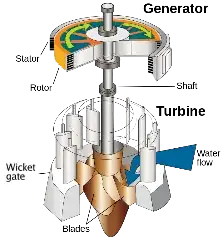
Water turbines are a major source of electric power. A water turbine generally has only one rotor disk.

enter image description here

(from Old Moonraker at Wikipedia)

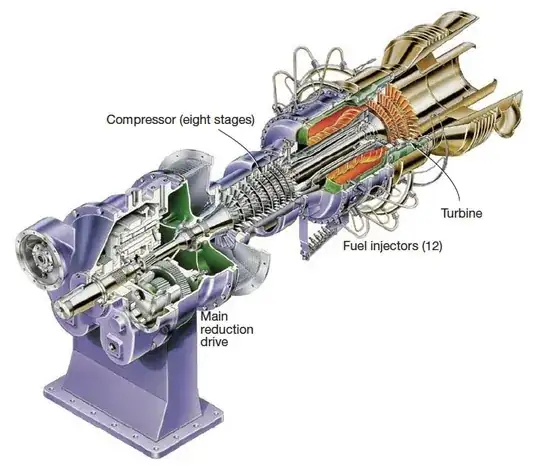
Gas turbines are used in natural gas electric power generators, jet aircraft, and a few other vehicles.

A gas turbine generally have lots of rotor disks, which can be divided into two groups: compressor rotor disks and turbine rotor disks.

The compressor section of a gas turbine needs lots of rotor disks, because reducing the number of rotor disks reduces efficiency by either (a) increasing the pressure differential across each disk to keep the total compression ratio the same, reducing compression efficiency, or (b) keeping the pressure differential across each disk the same, reducing the total compression ratio, which reduces the efficiency of the Brayton cycle.

Water turbines don't need a compressor section.

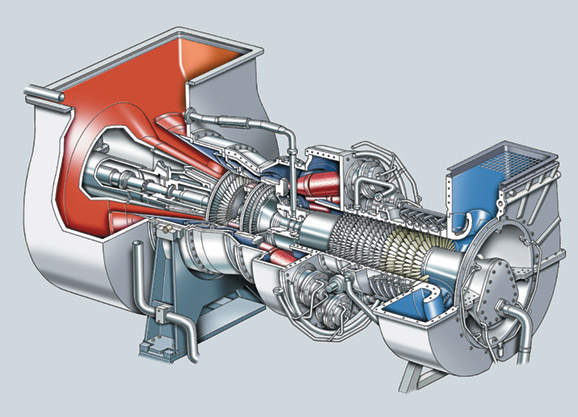
While in principle a gas turbine could have lots of rotor disks, in practice we find that aircraft turbines generally have only 1 or 2 rotor disks, and (bolted to the ground) natural gas turbines generally have only 1 or 2 or 3 rotor disks, not that much different from water turbines which have only 1 rotor disk.

Gas turbines used in electric power generators are oil-powered or natural gas-powered electric generators and are designed to extract as much energy as possible as electric power; the thrust pushing against the bolts holding them on the ground is unnecessary.

Examples:

(Hitachi H-25 from Russell Ray, Power Engineering)

(100-kW micro gas turbine photo from M. Cadorin et. al "Analysis of a Micro Gas Turbine Fed by Natural Gas and Synthesis Gas: MGT Test Bench and Combustor CFD Analysis")

Siemens Gas Turbine 200 (SGT-200) for industrial power generation

(from Tekla Perry: "GE’s New Gas Turbines Play Nicely With Renewables".)

enter image description here

(OPRA's 2 MW class OP16 gas turbine)

enter image description here

(natural gas or oil-powered Saturn 20 at Amherst College)

David Cary
  • 141
  • 3