13

So I understand that buoyancy happens because the fluid exerts larger amounts of pressure from beneath an object compared to above, like in this picture enter image description here

So my question is, what if the object is forced to the bottom of the container, so that no fluid is beneath it. The logic is, if there is no fluid beneath, there is nothing to push it up. So, would that object still experience buoyancy? If yes, why?

edit: interesting to see some answers disagreeing with each other. One thing to note - according to my textbook buoyancy is a force that happens because of hydrostatic pressure - it has nothing to do with density of the objects. So those who say then can will experience buoyancy because it is less dense are wrong I guess, that is not buoyancy.

JMac
  • 992
  • 9
  • 16
M. Wother
  • 361
  • 2
  • 8

4 Answers4

3

Yes your can will still have buoyancy when it is submerged to the bottom.

Regardless of the submersion depth, any object will lose weight equal to the weight of water it has displaced, even when held at the bottom. You confuse the hydrostatic pressure with buoyancy.

Hydrostatic pressure will increase with depth, to a point that it may even crush the can in. But the buoyancy exerted by water on the can stays more or less the same, because water is almost incompressible, so its density is more or less the same at shallow and deep water. Hence the displaced water will weight the same on the bottom and buoyancy it causes would be the same.

kamran
  • 23,517
  • 2
  • 22
  • 42
2

Yes it will - the space the object occupies is lighter than the fluid around it so it wants to rise.

Same as pushing a ball to the bottom of the bath - does it stay there?

Edit: for those who say the shape of the ball makes all the difference: try it with a plastic hollow cube (filled with air) so the cube can lay flat on the surface...

Solar Mike
  • 16,242
  • 1
  • 27
  • 33
2

This question is a theoretical/academic edge-case.

A body in the water will experience two forces:

  1. Pressure acting on all surfaces in contact with water
  2. Gravity acting on the mass of the body

The articel on buoyancy over at Wikipedia explains very good how the following equations are set-up. This article also gives the defintion of buoyancy as:

In physics, buoyancy or upthrust, is an upward force exerted by a fluid that opposes the weight of an immersed object.

(The reader has to decide whether a body on the ground is still immersed.)

The buoyancy force, $F_\mathrm{B}$, can be calculated by integrating the stress (here: pressure), $\sigma$ across the whole surface, $A$, of the body:

$F_\mathrm{B} = \oint \sigma\, \mathrm{d}A $

For an immersed body on can use Gauss theorem. This means one can replace the area-integral with a volume-integral. However, in this edge-case the aera-integral of the body is not "closed". As the can sits on the ground there is no water(pressure) at the bottom side of the can (see also the explanation over at Physics.SE 1, 2).

This means for the edge-case, that the body has contact with the ground it is not possible to use the equation based on the volume-integral:

$F_\mathrm{B} = \rho \cdot V_\mathrm{displaced} \cdot g$

The only way to compute the buoyancy force is to integrate the pressure-vectors on the surface of the body.
This means for a perfect flat ground and a perfect can the aera-integral becomes:

$F_\mathrm{B} = -p_\mathrm{at-top-of-can} \cdot A_\mathrm{top}$

The net-force (buoyancy and gravitational force) is:

$F_\mathrm{net} = -p_\mathrm{at-top-of-can} \cdot A_\mathrm{top} - m_\mathrm{can} \cdot g$

Whether $F_\mathrm{B}$ in this case should be called buoyancy needs to be discussed.

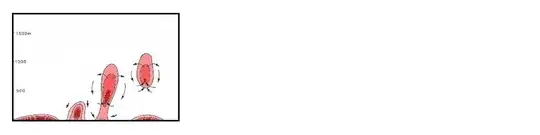
A very similar effect are thermals. When sun light wars the air on the ground its density reduces as with your object under water you have no upward (pressure-)force because there is nothing beneath the war air bubble with a higher density. You need a disturbance if this stable system, which brings some higher density fluid underneath the low density area in order to get buoyancy. The following figure from here illustrates these steps. picture of thermals
rul30
  • 1,202
  • 10
  • 24
2

I'm not sure why SolarMike deleted his response. The only thing holding the can to the ground ("proud" in naval terms) is the vacuum force, i.e. the same pressure that keeps you from lifting the can off a table if there's a perfect seal to the table.
So long as the can's density is less than that of the surrounding fluid it'll experience a buoyant force. Don't confuse an existing force with the net force . Once there is a channel to allow water to flow under the can, the delta pressure of the water with depth will cause the can to rise to the surface. (It's a matter of the pressure vs. depth, not the density). As shown on the Wikipedia page, the pressure at the bottom of the can (water pressure) is greater than that at the top of the can, thus forcing the can to rise. This pressure differential exists even when the can is proud; it's just the lack of pressure that would result if a vacuum were to form there that holds the can to the ground. So, in sum, the can always sees a buoyant force.

Carl Witthoft
  • 4,289
  • 1
  • 14
  • 13