5

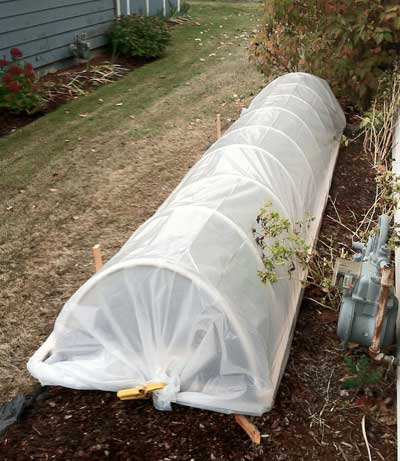
enter image description here

Source: Low Tunnel Construction: How to Build a Mini Hoop House

I have a small greenhouse that I want to keep as cold as possible in the spring. I plan to cover the greenhouse with a polyethylene tarp to shield it's contents from the sun.

However, I'm not sure what colour of tarp would be the most effective at shielding heat.

I suspect that light coloured tarps would allow for solar gain. And I wonder if a black tarp might also retain warmth by absorbing heat from the sun.

Question:

Are there specific colours of material that are known to let in the least amount of heat?

user7083
  • 570
  • 3
  • 19
User1974
  • 523
  • 4
  • 19

5 Answers5

4

As a practical and cost effective solution, I'd advise using aluminium foil, or tin foil as it's also called. Please realise that it's rather fragile, so it's best to glue it to a plastic foil or something to keep the wind from ripping it apart. It doesn't really matter if cracks get in the foil. Use the most shiny, reflective side of the foil as the outside. This maximises reflection of heat in the form of radiation.

Make your roof wider, so it covers more ground surrounding your crops. If the sun is able to heat up the ground right next to your crops, the heat in the ground will travel to the ground under your crops, and ending up also heating the crops themself. You don't want that.

You can't get or keep it any cooler than the surrounding air, so make sure it's ventilated, to keep temperatures as close as possible to outside air. That's the lowest you'll be able to go. Therefore, don't hermetically insulate your crops like you did in the picture, but enable it to ventilate. No insulation can keep all the heat outside. It will let through more or less heat. Any heat that is let through by the roof is removed by ventilating. If you cover them like in your picture, any heat let through by the roof is instead kept under it.

I'd advise to set up your roof like this. You'll also keep the ground surrounding the crops as cool as possible this way, minimising any heat conducted to the crops.

roof

Air
  • 3,211
  • 4
  • 26
  • 47
Bart
  • 1,204
  • 6
  • 12
3

I would suggest a reflective mylar film such as those used for survival blankets. That would be the most effective single layer solution. Adding additional layers of plastic would further insulate the ground from the warmer air in the tunnel.

Donald Gibson
  • 1,078
  • 6
  • 11
1

White and silver are the most reflective (not absorb heat from the sun). There is some debate about which is more reflective. A white tarp is probably going to be cheaper.

paparazzo
  • 499
  • 2
  • 8
0

@donald Gibson is correct, i will add this note: a black tarp will exclude heat because it absorbs it. but after absorbing it, its temperature goes up and it begins re-radiating the heat which includes off the shaded side of the tarp- which means that any tarp that excludes the transmission of infrared (heat) radiation by absorbing it will inevitably fail to block heat because that absorption inevitably gives rise to radiation. the incident radiation must be reflected away, as pointed out by @Donald gibson.

niels nielsen
  • 15,513
  • 1
  • 15
  • 33
0

White reflect the greatest amount of solar radiation. I build and maintain Ice Runways for the National Science foundation, and any dirt or grease matter gets on the surface the solar gain on that item melt a hole in the surface of the runway and weakens the landing surface. We do everything possible to keep the surface white so the "albedo effect" reflects the greatest amount of solar energy to maintain structural integrity of the runway in the summer. https://nsidc.org/cryosphere/seaice/processes/albedo.html