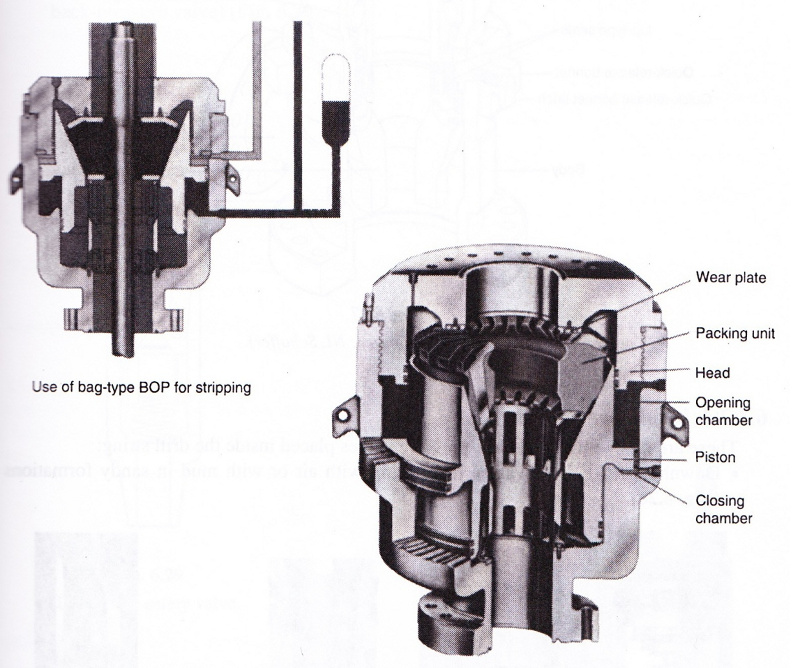
I am trying to calculate the force required to close the valve on an annular blow-out preventer. A rubber ring (called a packing unit) closes around the pipe when a force is applied from underneath, as shown here:

The actual valve has the hydraulic fluid coming into a chamber that goes the around the outside of the main body, which then lifts a piston which applies the force to the packing unit, as shown here:
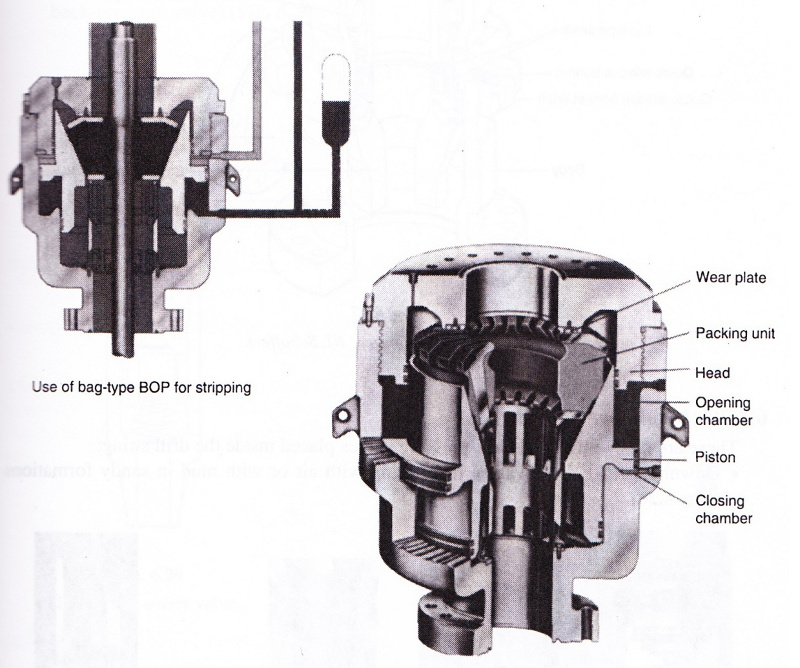
(source: geologie.vsb.cz)
In the documentation for the bop it says that the hydraulic pressure required to close or open the valve is 3000 PSI.
From this, how do I calculate the force to close the valve?
I assume you just multiply 3000 by the area the pressure is acting on:
$$3000*6894.7*(\pi R_o^2 - \pi R_i^2)$$
Where $R_i$ and $R_o$ are the inner and outer radius of the ring, shown in the picture in the second link. Units of these are meters. $6894.7$ is to convert from PSI to N/m2.
But this gives a HUGE force. Am I doing something wrong in the maths? Or am I interpreting the documentation wrong. Does a 3000 PSI closing pressure not mean that you have to apply 3000 PSI of pressure to the hydraulic fluid acting on the outer ring of the piston? Maybe it means that 3000 PSI is needed to squish the packing unit so it closes? In this case what information do I need and how do I calculate the force required to close the valve?