4

I aim on building a silent, completely passively cooled PC, with no moving parts at all (I am aware that it is cheaper to go for an inaudible computer instead, using low speed fans. This is not the point.).

I came up with the idea to install not one but two CPU coolers, of which in theory one alone should keep a high performance CPU cool only using natural convection, but not in practice. For this I thought of using a triangular shaped piece of copper, with thermal compound between each surfaces.

Will this improve heat dissipation compared to a single heat sink or is the thermal resistance of the copper block a problem? I sketched the idea below:
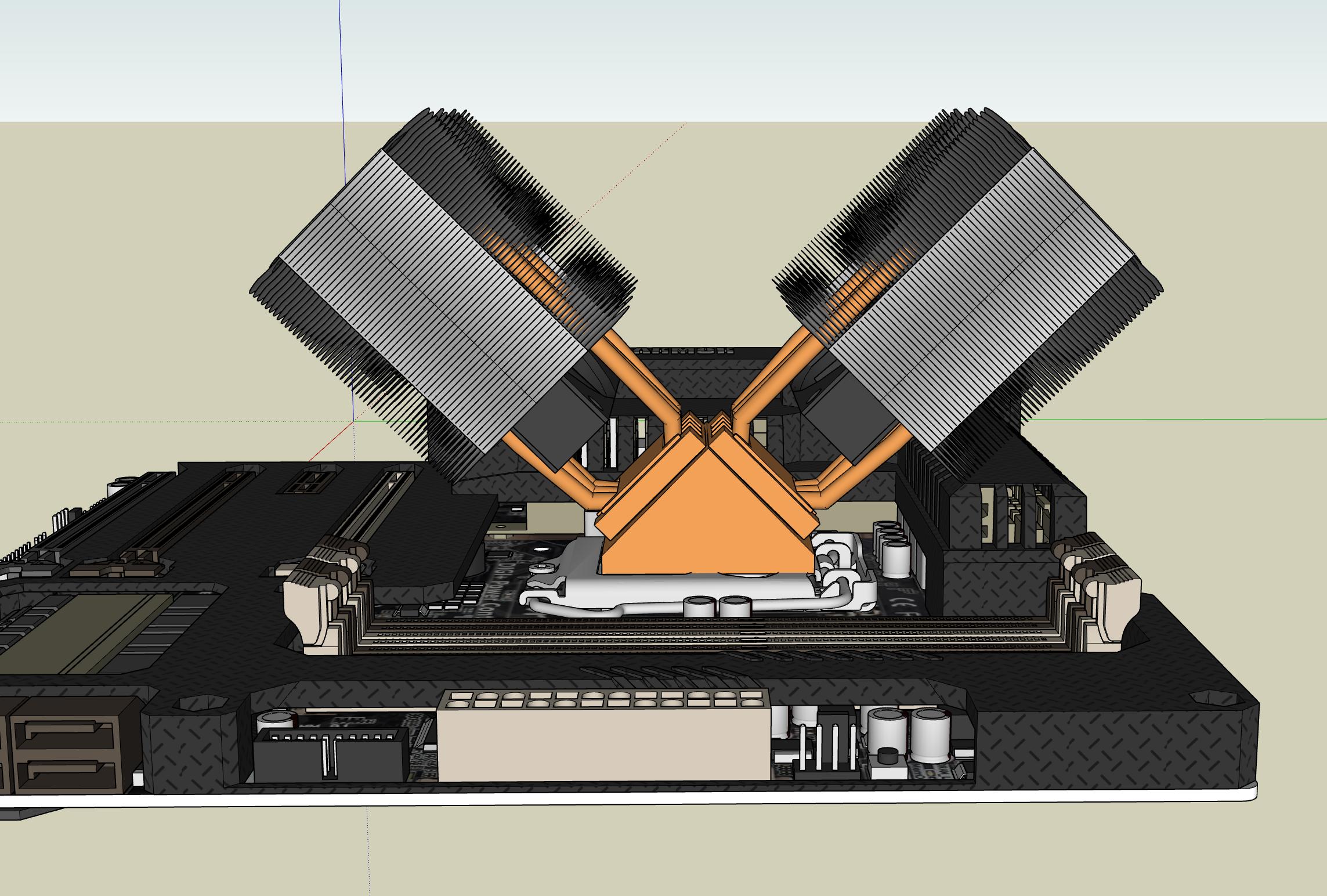
enter image description here

Benjoyo
  • 141
  • 3
  • if copper is a problem, use silver :) – Solar Mike May 23 '18 at 15:34
  • Yes the heat resistance of the block would be a problem. – paparazzo May 23 '18 at 17:32
  • Does it have to be passive, or are you willing to deal with T-E coolers and a slightly more remote radiator assembly? Or, can you put fluid into those Cu tubes and use a heat-pipe methodology? – Carl Witthoft May 23 '18 at 17:49
  • Please show your analyses as well as any experimental data to explain how a single sink (of indeterminate height!!) fails. – Carl Witthoft May 23 '18 at 17:50
  • If you could thread the heat pipes through the 'wedge' block to draw heat from it efficiently, it should work. If you just stick two radiators on top of a solid (or worse, hollow) metal wedge, you're getting nowhere. – SF. Jul 10 '18 at 13:25
  • @CarlWitthoft: Considering the heat generated by a thermoelectric cell, it won't work with a passive radiator of any sane size. Peltier cells are good for getting a little more oomph from an already extreme rig with powerful active cooling. They are bad for passive solutions. – SF. Jul 10 '18 at 13:29
  • I'd rather go the water cooled route in this case. You can locate your dissipator to the best location (bottom or top of the case) and having it less in the way for other parts. If you don't want a pump, then only use the natural thermo-syphon working, and use a thin, large surface radiator. You could even mount it completely external, or in another room. – Bart Jul 10 '18 at 21:08
  • @Bart: passive watercooling based on thermosyphon necessitates rather excessively sized radiators. Something the size of a truck engine radiator might be about right, or a little too small. – SF. Jul 10 '18 at 23:54
  • @SF. I don't think so if he can manage to get a little airflow through it, that may be possible when placing it at the top or bottom. Maybe in addition to heatsinks right on the processor. Cars did use thermosyphon and their engines produced considerable heat. Their radiators weren't huge, but they did have a fan to get some air through it though. – Bart Jul 11 '18 at 18:48
  • @Bart: car engine operational temperature is much higher than CPU and they still force air through the radiator. If you let water block on the CPU run near boiling point, you're not doing a very good job of cooling it. – SF. Jul 12 '18 at 05:08

2 Answers2

3

Well, I would think that two smaller ones rigged up in an "amateurish" fashion (apologies, but that's we both are, right) are going to be worse than just one (sufficiently large) properly mounted heatsink. That giant triangular piece closest to the CPU would probably delay heat transfer -- even if you have excellent cooling on the other side of it.

What I have done was to use just one cooler, and that is sufficient if you choose one that's large enough.

I have one giant case (Antec 182) with a giant heat sink (Thermalright HR-1) which never even gets lukewarm under load of a 3.something GHz cpu.

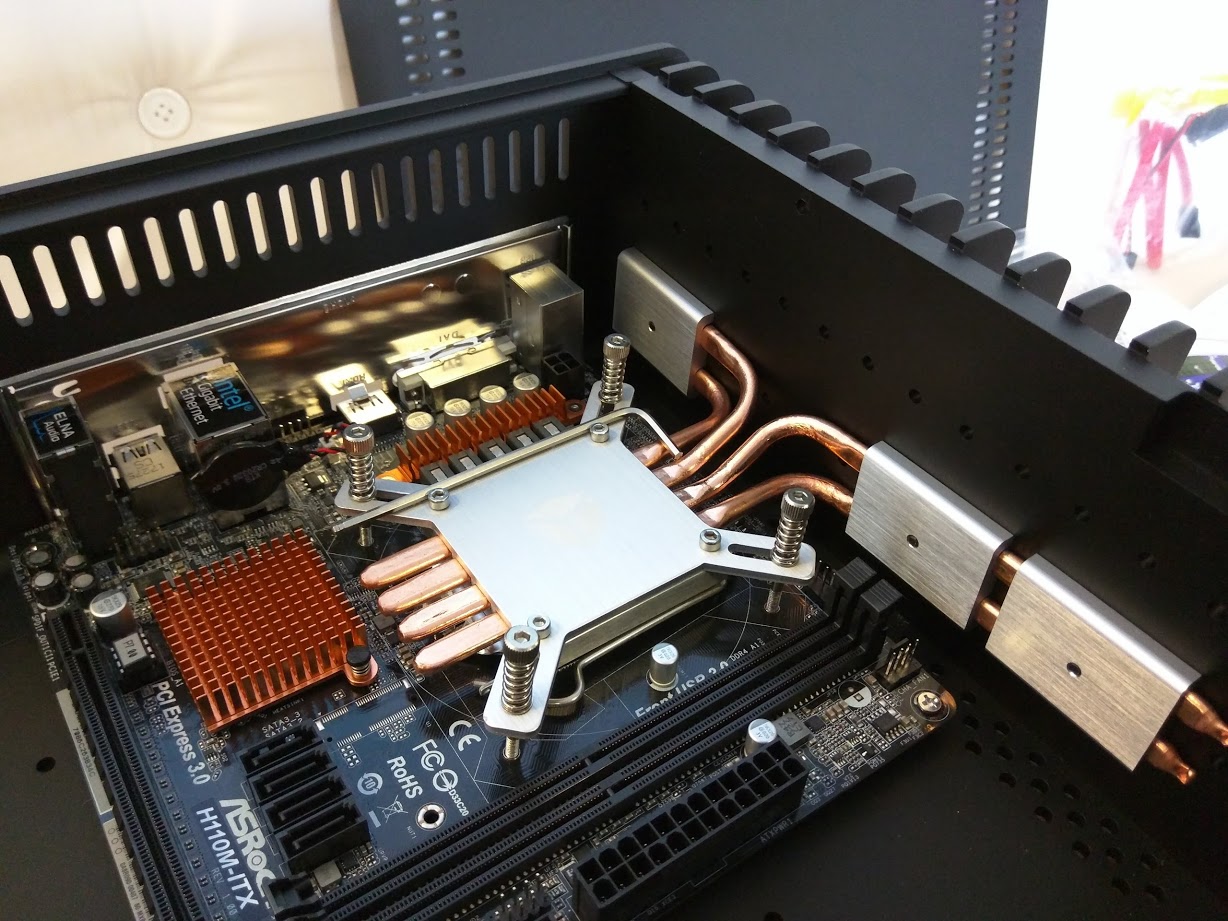
I have an HTPC case (Streacom FC10) in which the sides themselves are giant heat sinks connected to the CPU and PSU by way of heat pipes. This also works excellently, and is fully enclosed.

Edit: Here's what the case-as-heatsink solution looks like: enter image description here

KlaymenDK
  • 241
  • 2
  • 8
0

I was going to suggest a Streacom case, I've had one for years and it works excellently.

Looking at your original design, if you could get the triangular block made as a vapour chamber instead of a solid block it might actually work. You'd need to consult with a company that makes heat pipes to see if the triangular shape would work or not. Given the diagrams I've seen of how they normally work I'm guessing not due to the varying and long distances between input and output surfaces, but would be an interesting engineering exercise that could have unexpected results. Who knows, you might have stumbled on a great design and they could manufacture it for you...

As to your build, these high density heatpipes might be of interest: https://www.fanlesstech.com/2018/09/flat-cool-pipes.html