So if your fan doesn't produce a minimum of 1m of water (which is about 2.9 inHg), there would be no flow. Afterwards, it depends upon your fan curve. You would find that the system curve would likely equal 2.9 inHg + K*Q^2, where Q is the flowrate and K is a factor that depends upon how you move the flow - note with smooth curves K is small, and with sharp turns and disruptive contours, K is large.
Wherever your pump curve intersects this system curve is the flow rate. Plain and simple. Once you know the flowrate, divide the volume to move by the flowrate to gain the time estimate.
Edit:
With a wet/dry vacuum style compressor, you're most like to see a curve similar to this one:
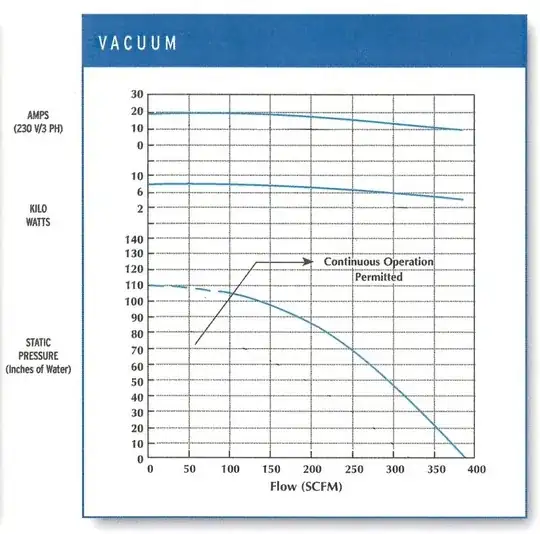
At the 40" of water (approx. 1 meter), the vacuum would remove 300 cfm of air (and therefore water) a minute. At less than 100 cfm removal, the vacuum would stall. So, you should expect removal between 100-300 cfm, or between 3-9 seconds.


