11

Most people have had the experience of moving the tab of an aluminum can back and forth until it breaks off. It usually only takes a few complete back and forth motions before the tab breaks off.

Aluminum can with stay tab

What is the root cause of the tab breaking off?

The possible causes seem to be:

  • A fatigue fracture.
  • An overstressing of the metal.
  • A result of plastic deformation.

But which one is it?

hazzey
  • 10,730
  • 11
  • 46
  • 96

3 Answers3

14

Every time you bend aluminium below the recrystallisation temperature, the macroscopic grains become smaller: this is known as cold work. The sides of the tab are either stretched or compressed. The effect is the same as the rolling example below. This is indeed a plastic deformation: the tab stays in place and doesn't bend back and stays in place.
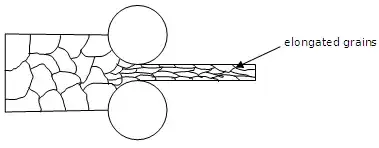
cold work

Source

What you've just done is to make it harder for those grains to slip over each other, making the material harder and increasing it strength. You have however also made it a lot less ductile (and more brittle). If you bend a spoon, it's hard to bend it back to the correct shape. This is because that area has been cold worked and is stiffer than the surrounding metal.
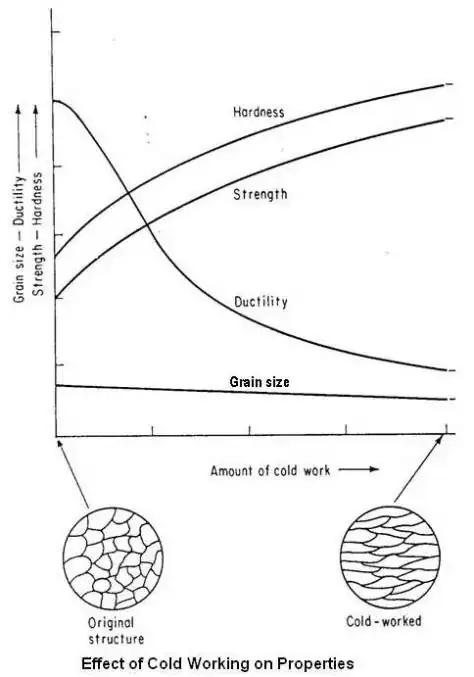
graph

Source

The same happens with your aluminium tab, except that there comes a point where it snaps. You can think of it like the beam below: You're bending it with a fixed deflection that corresponds to a certain angle θ. At some point as your ductility drops, you're going to go past the strain limit and it will snap.
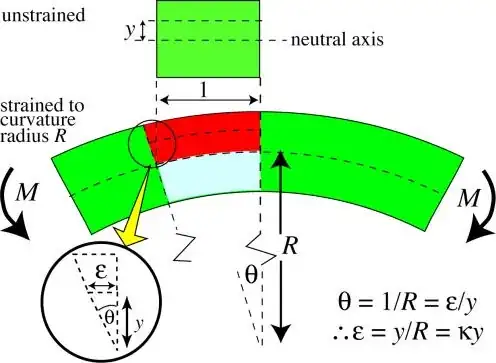
bending

Source

While it might appear to be fatigue, from an engineering perspective is really not the correct term to use. Fatigue is used to describe problems typically appearing after several thousand load cycles.

BeyondLego
  • 950
  • 6
  • 11
1

Fatigue is the stress on a material due to cyclic loading. The best comparison is a rubber band. When you pull it over and over it stretches out because the fatigue is causing the elasticity to wear out and it becomes more and more plastic until the band snaps. While technically the the tab is breaking because of plastic deformation, fatigue fracture would be more correct be the plastic deformation doesn't cause a fracture until the tab has been loaded significantly more times than the life-cycle intends.

1

Almost everyone is partly right. You can fail the ring-pull by simple overload in one 'cycle' or you can accumulate plastic strain in three or four cycles. This wouldn't normally be considered even low-cycle fatigue but I don't know that there's a lower limit on how many cycles Paris' Law can be applied.

rdt2
  • 314
  • 2
  • 4