3

Consider a balloon, it is a flexible, expanding pressure vessel made of synthetic rubber. I am trying to design a system that will use hemispheric pockets of neoprene to grip an object, much like the one found in this journal:

H. Choi and M. KoƧ, 'Design and feasibility tests of a flexible gripper based on inflatable rubber pockets', International Journal of Machine Tools and Manufacture, vol. 46, no. 12-13, pp. 1350-1361, 2006. (Behind a paywall, abstract available here)

Although I am not entirely certain where to start, I am dealing with a high pressure (8 bar) and need to work on a small scale (max radius of 40mm).

Values I have recieved from equations found online suggests thickness values in meters and radius expansion reaching the hundrends of meters.

What equations do I need to calculate a solution?

Are neoprene, latex and chloroprene viable materials to use or should I find alternatives?

Is a hemisphere that best pocket shape I can use?

Additionally, how can I calculate the amount of expansion?

Sam Weston
  • 607
  • 1
  • 5
  • 15

2 Answers2

3

This is fully doable. This is the in the higher range as bicycle tires (although with the outer tire as well and not the inner tube alone).

Alright, here goes:

What equations do I need to calculate a solution?

The pressure in a tube can can be modelled by the following equations:

Hoop Force:

$$\sigma_H = \frac{pr}{t}$$

Axial Force

$$\sigma_A = \frac{pr}{2t}$$

Is a hemisphere that best pocket shape I can use?

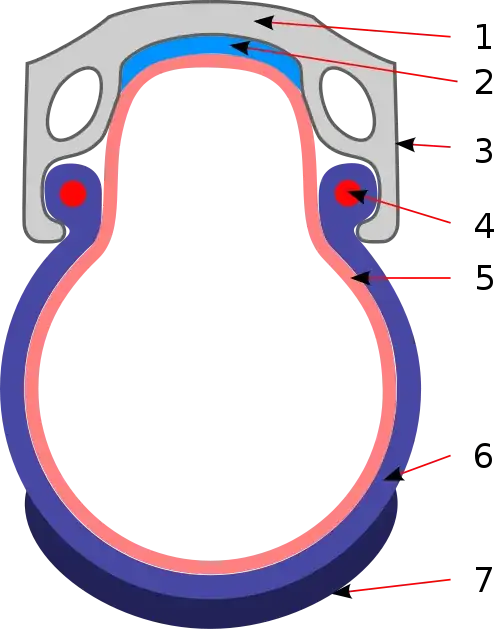
That is a design question, although when inflated it should ideally be cylindrical to prevent extra stress. This is a bike tyre picture from Wikipedia:

enter image description here

Are neoprene, latex and chloroprene viable materials to use or should I find alternatives?

Neoprene I imagine will leak air, although slowely. Latex and chloroprene should work. I would suggest that you get bike parts to do this if you are trying to build a prototype.

Additionally, how can I calculate the amount of expansion?
Your system is a little dynamic here so it will get bigger as you fill it with pressure.

  • Rewrite the equations above with $\epsilon E $ to replace $\sigma$.

  • With a constant pressure and E-modulus you should be able to get the final strain.

BeyondLego
  • 950
  • 6
  • 11
-2

Bicycle tires have pressures way below 8 bars. Pressure is a minor issue, look for standard pipes, pipe closures or joints in a hardware shop, HomeDepot etc.

Narasimham
  • 287
  • 2
  • 9