The general name for what you're trying to make is a 'thrust bearing.' That means something that allows a shaft to move relative to another part, with the load being axial (down the shaft) instead of radial (perpendicular to the shaft.)
There are many types of thrust bearings, but I'm going to guess that you're looking for a simpler, lower cost solution. I'm just basing that on the fact that your plate is made out of wood.
One simple method is to use a device called a shaft collar. 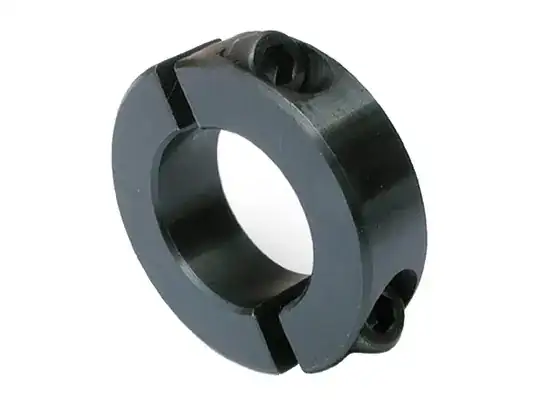 which is just a round clamp you can attach to your shaft to keep it from falling through the hole. Shaft collars are made in many different styles, but all operate on the same principle. It should be easy to buy one for your size of shaft.
The problem here is that if your machine runs very fast, or for more than a few minutes, the shaft collar will slowly drill through your wooden plate. To solve this, you would want to put something between the shaft collar and the wooden plate. The cheapest solution is to use a piece of plastic - UHMW is a fairly good material for this, and is pretty affordable. They also make bronze thrust washers specifically for this purpose, which are surprisingly affordable. For example, look at McMaster Carr Part #5906K513. Stacking one or even two of these between the collar and the wood would make the bearing last for a pretty long time as long as your machine isn't moving very fast.
If your machine does move very fast, you'll want to look into rolling element thrust bearings (for example, McMaster #5909K44,) which work much better and last longer, but are a bit more expensive. Rolling element bearings are also much less tolerant to abuse (dirt, dust, impact) and some require lubrication. You may also want to look at getting a shoulder machined into your shaft in that case, rather than using a shaft collar.
Don't forget to check that the wood is strong enough, 30kg of suspended load is nothing to sneeze at.


