4

I am currently building a mini boat-like robot to clean the water from floating trash. I used two servo motors to move the loader that I have installed in front of the boat, and two 3 V DC motors installed in the back to allow the boat to move across the water. I also used Arduino to program my servos and motors. When I tried to test my robot in water, the two DC motors did not push the boat forward. Why didn't the air push my boat? Here are the materials that I used to build my robot:

  • Two 1 L water bottles
  • A small plastic box to hold the electric circuits.
  • Another small plastic box to serve as a trash collector.
  • Two plastic propellers (taken from a mini fan).
  • A toy loader.

The total weight of the boat is around 700 g. The picture below is the robot I am working on:
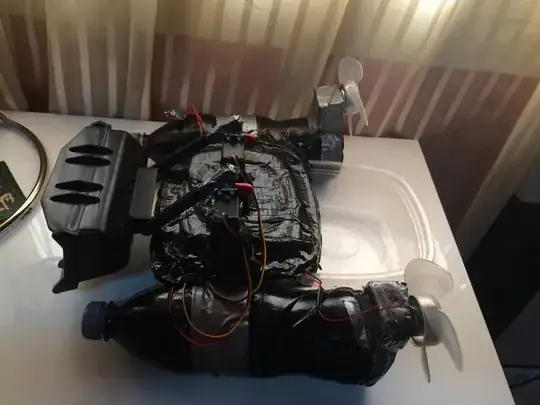
enter image description here

Chris Mueller
  • 6,456
  • 2
  • 29
  • 56

2 Answers2

6

Your fans are too small. If you hold 1 and make it go max speed you will barely feel the force it applies.

Instead consider a drive-train going into the water and turning a screw. Because water is much more viscous and dense you get much better acceleration.

ratchet freak
  • 6,752
  • 21
  • 23
3

Your air propellers did push your boat, but the delivered thrust was not enough! As ratchet freak an Dan said, the density of the medium in which the propeller is working is of great importance, as the delivered thrust $T$ is roughly calculated by:

$$ T = c_{th} \frac{\rho}{2}v^2A_{prop} $$

nevermind the factor $c_{th}$ but you easily see that

$$ T \sim \rho $$

and as the density $\rho$ of water is approximately 1000 times higher than the density of air, a propeller in water will generate significantly more Thrust given the same circumstances as for the same propeller in air.

Knigge46
  • 111
  • 7