5

I'm trying to make a simple Venturi tee which will have air flow through it while sucking some water from down below (like paint sprayers do). I want the device to pull the water to a height of 1 meter.

That means that I need 0.1 atmospheres (104 Pascals). The dynamic pressure equation states that $P_{a}=\frac12\rho v^2$, meaning that $v=2P_a/\rho$. The density of air is $1.22 kg/m^3$, $P_a$ is 104 so $v=128\ \mathrm{m/s}$.

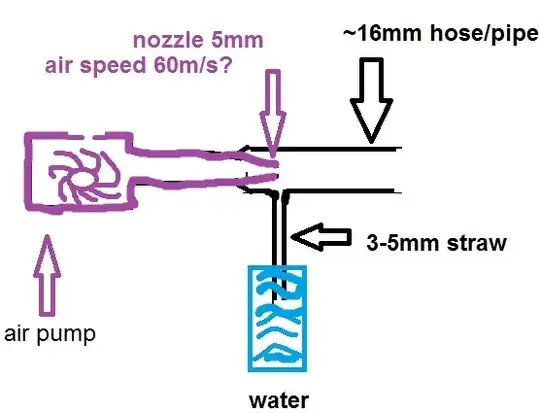
I experimented a bit with my air pump and found out that with a nozzle of ~5 mm in diameter I can fill a 10 litre bag with air in ~7 sec. That should mean that the velocity is around 60 m/s. With those results I took a hose of 16 mm in diameter, stuck my pump nozzle inside (from one side) , made a small hole juxatoposed to the nozzle from above (maybe 3-5 mm diameter) and stuck a straw in it. When I turn the apparatus on, hovewer, the straw (placed in a bottle of water) lifts the liquid for no more than several millimeters.

Why does my Venturi pump not work?
enter image description here

Air
  • 3,211
  • 4
  • 26
  • 47
dactylo
  • 1
  • 1
  • 1
  • 4

2 Answers2

7

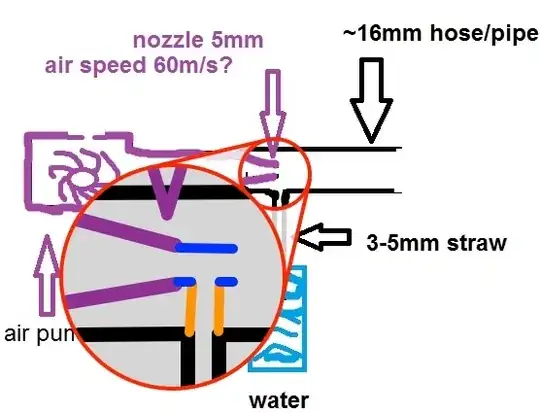
The problem is that the airspeed drops as soon as the airflow leaves the nozzle. It is not the same as a water-jet expelling into air (in that case the density of the water is much greater than that of air so the water holds its velocity much better). The low-pressure air will suck in air from around it in the wider pipe and thus become turbulent around the outside edges of the cylindrical stream within a very short distance as it leaves the nozzle, and slow right down. The airflow will still be fast in the center of the cylindrical stream, but not at the edges where your intake is. You need to position the intake of your straw inside the nozzle, at its narrowest point. Modified version of the diagram from the original post

I have drawn a zoomed-in part of your diagram and shown an extension to the nozzle in blue, also an extension to your intake in orange so that it opens inside the fastest part of the airflow. If you can't modify it in this way, at the very least place the intake right up as close as possible to the exit-point of the nozzle, but ideally you want the intake to come in just before the air exits the nozzle. Additionally, make the 'straw' and intake about half the diameter of the nozzle exit, as it will lift the water much more easily.

jhabbott
  • 5,990
  • 8
  • 32
  • 63
0

enter image description here

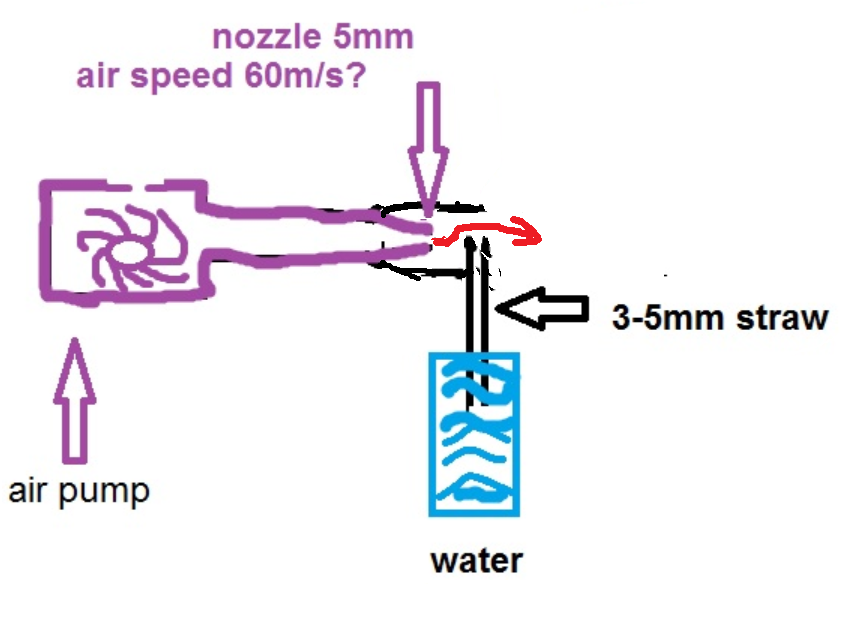
Your device must be improved. The straw must be inserted into a horizontal tube, which means that the mouth of the straw should be inserted into the airflow sprayed from the nozzle, as shown by the red curve. Due to the obstruction of the straw, the airflow will first bend upwards and then bend forward. This will create a pressure below atmospheric pressure at the mouth of the straw, causing water to be drawn up. This is similar to the upper surface of a wing, where the airflow first bends upwards and then downwards and backwards, resulting in pressure below atmospheric pressure.

@jhabbott What jhabbott said is also based on reason, which utilizes the contraction section inside the nozzle to bend the airflow upwards, thereby generating a pressure below atmospheric pressure at the mouth of the straw. Your water tank is connected to atmospheric pressure, so the straw must generate a pressure lower than atmospheric pressure in order to suck up water.

enbin
  • 97
  • 5